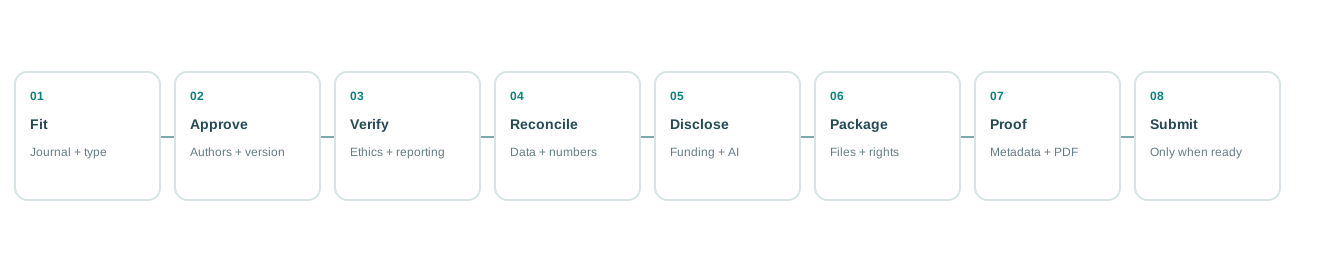
1. The Submission Checklist Is a Final Scientific Audit
A submission checklist should not be treated as a clerical exercise performed after the science is finished. Its purpose is to confirm that the manuscript, supporting files, disclosures and submission metadata tell the same scientific story and that an editor can assess the work without first resolving avoidable inconsistencies.
The final audit should therefore be performed on the exact files that will be uploaded, not on an earlier draft. Authors should verify scientific content, ethical documentation, reporting completeness, authorship, data and code statements, figures, references, permissions and journal-specific requirements as one connected package.
A checked box is meaningful only when the underlying requirement has actually been verified. Treata recommends assigning a final human owner for the submission package—normally the corresponding author—while preserving shared responsibility across all authors.
2. Confirm Journal Fit, Article Type and Current Instructions
Before technical preparation, confirm that the target journal still fits the manuscript’s subject, article type and intended audience. Read the journal’s current Aims & Scope, article-type requirements and author instructions immediately before submission because limits, required forms and file specifications can change.
Confirm the correct article type. Article-type selection affects structure, abstract format, reporting guidance, word limits, figures, supplementary files and sometimes editorial routing. Do not select a shorter or more convenient category if it misrepresents the work.
Where journal-specific instructions differ from general Treata guidance on formatting or submission mechanics, the journal-specific requirement controls unless it conflicts with a publisher-wide mandatory integrity or ethics standard.
3. Freeze the Author-Approved Submission Version
All authors should know which manuscript version is being submitted. Last-minute edits made after co-author approval can create discrepancies in authorship, data, conclusions, disclosures or references.
Create a clearly identified submission version and verify that all authors have had an appropriate opportunity to review and approve it. The corresponding author should confirm that author names, order, affiliations and contribution statements reflect the group’s agreement.
If substantive analysis, interpretation or conclusions change after final approval, obtain renewed author approval rather than assuming earlier approval automatically covers the revised work.
4. Audit the Title Page and Submission Metadata Together
The title page and online submission form should agree on the manuscript title, author names, affiliations, corresponding-author details and other identifying metadata. Differences between the uploaded document and submission system can propagate into editorial records and eventually into publication metadata.
Check spelling, initials, institutional names, departments, city/country information and corresponding-author contact details. Where ORCID identifiers are supplied, confirm that each belongs to the correct author rather than copying identifiers between records.
Also verify word counts, numbers of tables and figures, article type, keywords and any running title if requested. ICMJE’s current manuscript-preparation guidance specifically notes the usefulness of word counts and accurate counts of figures and tables for editorial assessment.
5. Verify Authorship, Order and Contributions
Confirm that every listed author satisfies the applicable authorship criteria and that contributors who do not qualify for authorship are recognized appropriately. Authorship should not be granted for status, supervision, funding or affiliation alone, and qualifying contributors should not be omitted.
Reconfirm author order, co-first or co-senior designations where used, and the corresponding author. Ensure the contribution statement—such as a CRediT-based statement where the journal uses it—describes actual work and does not function as a substitute for authorship eligibility.
Resolve authorship disagreements before submission whenever possible. If an authorship change becomes necessary after submission, follow the journal’s formal process rather than silently changing the manuscript file.
6. Reconcile Funding, Competing Interests and Support
Funding and competing interests are related but separate records. Verify funder names, grant numbers, recipient authors and the role of funders or sponsors in design, conduct, analysis, writing and publication decisions.
Each author’s relevant financial and non-financial relationships should be disclosed according to journal requirements. Compare the manuscript, disclosure forms, cover letter and submission-system answers so that one location does not say “none” while another reports a relationship.
Also identify medical writing, statistical, translation, technical, editorial or in-kind support when relevant. Acknowledgment of support should not obscure who controlled the data, analysis and decision to submit.
7. Confirm Ethics Review, Consent and Participant Protection
For research involving humans, confirm that the manuscript accurately reports the ethics committee, IRB or REC determination, including approval identifiers where applicable. Distinguish approval, exemption, waiver and a determination that an activity is not human-subject research; these are not interchangeable.
Verify informed-consent requirements, waivers and publication consent separately. Publication of identifiable participant information, images or case details may require specific consent even when research participation was covered by another consent process.
For animal research, confirm oversight, welfare reporting and relevant reporting standards. Ethics statements should match the actual approved protocol and should never be reconstructed from memory simply to satisfy a submission field.
8. Check Registration, Protocols and Prespecified Plans
Where prospective registration or a protocol is expected, verify registry name, registration number, registration timing and the exact link or identifier. Clinical-trial registration and ethics approval serve different purposes and both may need to be reported.
Compare the submitted manuscript against the registered or prespecified plan. Material changes in outcomes, analyses, sample size, eligibility criteria or other prespecified elements should be transparently explained rather than hidden through retrospective rewriting.
For systematic reviews, protocols, registered reports and other designs with prospective plans, ensure that the manuscript clearly distinguishes prespecified decisions from later exploratory changes.
9. Apply the Correct Reporting Guideline and Extensions
Select the reporting guideline according to the study design, not merely the journal section. EQUATOR identifies major families including CONSORT for randomized trials, STROBE for observational studies, PRISMA for systematic reviews, SPIRIT for trial protocols, STARD for diagnostic accuracy, TRIPOD for prediction models, CARE for case reports, COREQ/SRQR for qualitative research, ARRIVE for animal studies, SQUIRE for quality improvement and CHEERS for economic evaluations.
Check whether a relevant extension applies—for example, an AI-focused, abstract-specific or specialty-specific extension. A completed checklist should map each applicable item to where it is reported; “not applicable” should be used only when genuinely justified.
Reporting checklists are tools for complete reporting, not substitutes for sound study design. EQUATOR describes them as structured tools defining minimum information readers need to understand, replicate or use research.
10. Perform a Manuscript Architecture and Completeness Check
Read the manuscript once for structure rather than prose. Confirm that each required section is present and that its content belongs there. Original research commonly follows Introduction, Methods, Results and Discussion, while other article types may require different structures; ICMJE explicitly recognizes that format should follow the nature of the article.
Check that the abstract reflects the full paper, the Methods explain what was actually done, Results report the analyses described in Methods, and the Discussion does not introduce unreported primary results. Conclusions should remain proportionate to the design and evidence.
Ensure that supplementary material necessary to understand the work is submitted with the manuscript for editorial and peer-review assessment rather than added only after acceptance.
11. Run a Numerical and Statistical Consistency Audit
Cross-check the abstract, main text, tables, figures and supplementary material for sample sizes, event counts, percentages, effect estimates, confidence intervals, P values and units. Small inconsistencies can undermine confidence because editors cannot know which version is correct.
Confirm that statistical methods described in Methods correspond to the analyses actually reported. Check denominators, missing-data handling, subgroup labels and rounding. Recalculate key percentages or totals where practical.
If analysis code is available, regenerate final tables and figures from the frozen analysis dataset when feasible. Manual transcription between software and manuscript files is a common source of preventable discrepancies.
12. Verify Tables, Figures, Legends and Image Integrity
Every table and figure cited in the manuscript should exist, be numbered in order and be interpretable with its title or legend. Check labels, units, abbreviations, axes, statistical annotations and consistency with the text.
For scientific images, verify that processing complies with the journal and Treata image-integrity requirements. Do not selectively add, remove, move or enhance features in a way that changes evidentiary meaning. Preserve original source files where relevant.
Confirm file format, resolution and separate-upload requirements. If an image or figure contains third-party material, determine whether permission, attribution or a license is required before submission.
13. Audit References Against the Original Sources
Verify references for existence, bibliographic accuracy and support for the claims attached to them. This is especially important for references introduced through reference managers, AI-assisted literature work or copied material.
Check DOIs and other identifiers where available, but do not assume that a valid DOI means the cited article supports the sentence. Authors should consult the original source for material claims rather than relying on secondary summaries.
Remove accidental duplicates, confirm retracted or corrected literature has been handled appropriately, and avoid citation practices designed primarily to inflate citations to authors, journals or organizations.
14. Confirm Research Data, Code and Reproducibility Materials
Identify the data that support the article and ensure the Data Availability Statement accurately explains whether and how they can be accessed. Repository names, persistent identifiers, accession numbers, controlled-access procedures and legitimate restrictions should be correct at submission.
Where code or computational workflows materially support the results, confirm that the archived or submitted version corresponds to the analysis reported. Include sufficient documentation, dependencies and version information for meaningful scrutiny when required.
Do not promise “data available on request” unless the authors actually have authority and a durable mechanism to fulfill legitimate requests. Sensitive data restrictions should be explained rather than disguised as openness.
15. Audit AI-Assisted Work Before Submission
Review AI use across the whole author group and relevant service providers. Determine whether AI was used only for low-impact language assistance or materially influenced writing, literature work, translation, code, data processing, statistical analysis, images or interpretation.
Verify every AI-assisted factual claim, citation, calculation, code segment, figure and scientific interpretation using independent sources or reproducible methods. Check that no confidential manuscript material, participant data, reviewer correspondence or restricted information was exposed to an unauthorized external AI service.
Prepare the disclosure required by the target journal and Treata’s AI policy. AI cannot be an author, and human authors remain responsible for all submitted content.
16. Check Originality, Related Work and Prior Dissemination
Confirm that the manuscript does not duplicate previously published work without transparent justification. Identify closely related manuscripts, conference abstracts, preprints, protocols, datasets or prior reports that an editor should know about.
ICMJE’s current submission guidance says authors should disclose submissions or previous reports that might be regarded as redundant publication and provide relevant material to the editor.
Preprints and legitimate prior dissemination may be permitted under journal policy, but they should be disclosed accurately. Do not attempt to hide overlap by changing titles, author order or wording.
17. Secure Permissions and Protect Third-Party Rights
Before submission, identify content that the authors did not create or do not control. This can include previously published figures, adapted tables, questionnaires, scales, photographs, maps, screenshots and substantial quoted material.
Determine whether reuse is permitted by license, falls within an applicable exception, or requires written permission. Preserve permission documentation and provide attribution in the form required by the rights holder and journal.
ICMJE’s submission guidance notes that permission may be needed for reproduced material, previously published illustrations, identifiable-person information and acknowledgment of contributors.
18. Build and Validate the Complete File Package
Create a final inventory before opening the submission system: main manuscript, title page if separate, figures, tables where separately required, supplementary files, reporting checklist, protocol or statistical analysis plan where requested, data/code documentation, permissions and required declarations.
Open every file after final export. Confirm that PDFs are readable, tracked changes are removed unless requested, comments are deleted, figures are not corrupted and filenames are clear. If the journal uses blinded review, inspect document properties and filenames for identifying information as well as the visible manuscript.
Do not rely on the upload screen as the first time anyone checks the exported files.
19. Prepare a Factual Cover Letter
A cover letter should help the editor understand the submission, not function as advertising. State the manuscript title and article type, briefly explain relevance to the journal, and provide required declarations.
Where applicable, disclose related submissions, prior reports, competing interests, authorship approval, research-conduct concerns or other information the editor needs. ICMJE’s current guidance specifically identifies these categories as appropriate submission-letter or form content.
Do not claim novelty, priority or clinical importance more strongly than the evidence supports. If suggested or opposed reviewers are permitted, follow the journal’s conflict-of-interest rules and provide accurate identifying information.
20. Complete the Submission System as a Second Scientific Record
Treat online metadata as part of the scholarly record rather than administrative duplication. Copying information into fields can introduce new discrepancies in titles, abstracts, author order, funding, conflicts, keywords and ethics statements.
After entry, compare the submission system against the final manuscript. Pay particular attention to author names and email addresses, corresponding-author designation, funding fields, data availability, ethics, trial registration and AI disclosures.
If the system asks a yes/no question that oversimplifies the study, use available explanatory fields or contact the journal rather than choosing an inaccurate answer merely to proceed.
21. Review the Generated Submission Proof
Many systems generate a combined PDF or proof after files are uploaded. Read that generated version. File conversion can remove symbols, alter equations, crop figures, reorder supplementary files or introduce font problems.
Confirm that all files appear, pages are complete and confidential or blinded information is handled as intended. Check that the abstract, tables, figures and supplementary items render correctly.
The final submission action should occur only after the generated proof and metadata have been reviewed by the responsible author.
22. Final Stop Conditions: Do Not Submit Yet
Pause submission if author approval is incomplete; authorship is disputed; required ethics documentation cannot be verified; registration information is inaccurate; a key analysis cannot be reproduced; important numerical discrepancies remain; required permissions are missing; confidential data were improperly exposed; references may be fabricated; or the disclosure record is materially incomplete.
A deadline does not convert an unresolved integrity problem into an acceptable submission. Correct the underlying issue first and document the resolution where necessary.
If the appropriate action is uncertain, seek clarification from the journal or relevant institutional authority rather than inventing information to satisfy a required field.
23. The 10-Minute Corresponding-Author Final Check
Immediately before clicking Submit, verify ten items: correct journal and article type; correct final manuscript; author list and order; ethics/registration; reporting checklist; funding/conflicts; data/code statement; AI disclosure; figures/references/permissions; and complete upload/proof.
Then verify that the corresponding author can access the email account used in the system and that all co-authors can respond to journal requests if confirmation is required.
This rapid check does not replace the deeper audit in this manual. It is the final defense against uploading the wrong file or leaving a known inconsistency unresolved.
24. Treata Submission-Readiness Standard
A Treata submission should be scientifically coherent, ethically documented, transparently disclosed, technically complete and internally consistent before editorial assessment begins. The manuscript, metadata, declarations, supporting files and submission-system answers should function as one record.
Authors should use the appropriate reporting guideline and journal-specific checklist where required. ICMJE notes that many journals use presubmission checklists and may require design-specific reporting checklists; EQUATOR provides a searchable library and study-design navigator for identifying appropriate guidance.
Journal-specific requirements may add file formats, limits, forms or declarations. They do not reduce publisher-wide expectations for research integrity, accurate authorship, ethics, transparency, data responsibility, disclosure and human accountability.
Connected author manuals
Complete the deeper checks
Canonical Treata standards