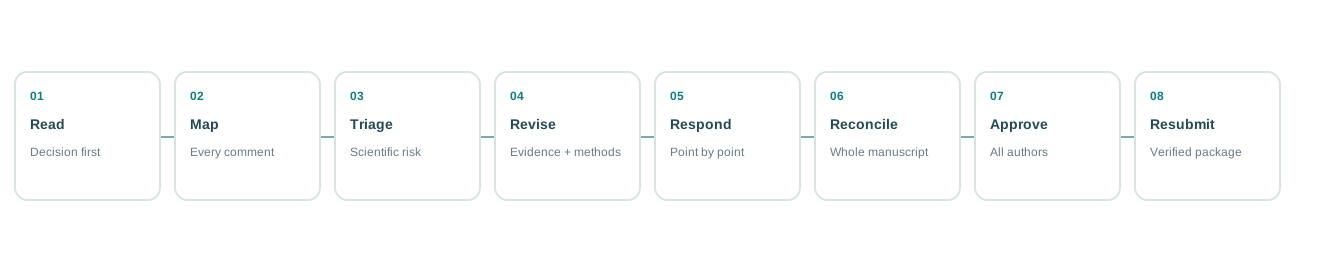
1. Peer Review Is an Editorial Process, Not a Negotiation With a Scorecard
A revision decision is an invitation to improve and clarify the scholarly record; it is not a promise of acceptance. Reviewers advise, editors decide, and authors remain responsible for the scientific content of the manuscript.
Authors should read the decision letter as a whole before responding to individual comments. Editorial instructions can take precedence over a reviewer suggestion, and comments from different reviewers may conflict. The goal is not to satisfy every sentence mechanically but to resolve the scientific and reporting issues that the editor needs addressed.
A strong revision makes the manuscript more accurate, transparent and useful even when the authors respectfully disagree with a requested change.
2. Read the Decision Letter Before Editing the Manuscript
Identify the formal decision, revision deadline, required files, formatting instructions and any editor-specific priorities. Separate mandatory editorial requirements from reviewer suggestions and from optional stylistic preferences.
Do not begin by changing isolated sentences. First create a revision plan that groups comments by scientific domain—methods, analysis, reporting, interpretation, ethics, data, figures and presentation. This reduces contradictory edits and makes it easier to identify comments that require co-author or statistical input.
If the decision letter is unclear on a consequential point, ask the editorial office for clarification rather than guessing what must be done.
3. Build a Traceable Response Matrix
Copy every editor and reviewer comment into a structured response document without changing its meaning. Number comments consistently and place the author response directly beneath each one.
For each comment, record the action taken, where the manuscript changed, and—when useful—the reason. Page and line references should correspond to the revised file the editor will see, not to an obsolete draft.
A traceable matrix protects against missed comments and helps co-authors audit the revision. It also allows editors and reviewers to distinguish a completed change from a promise to make one.
4. Triage Comments by Scientific Risk
Not all comments carry the same consequence. Prioritize concerns that could alter validity, participant protection, statistical interpretation, reproducibility, primary outcomes, data integrity or the central conclusion.
Next address reporting gaps that prevent readers or reviewers from understanding what was done. EQUATOR describes reporting guidelines as structured tools defining the minimum information needed to understand, replicate or use research, and they can therefore be valuable during revision as well as initial drafting.
Stylistic edits should come later. Polishing language before resolving a major analytical issue often wastes time because the affected sections may need to be rewritten.
5. Coordinate the Revision Across the Author Group
The corresponding author should coordinate the response, but should not become the sole scientific decision-maker. Route methodological, clinical, statistical, ethical and data questions to authors or contributors with the relevant expertise.
Material changes to analysis, results or conclusions should be visible to all authors before resubmission. Reconfirm final approval after the revision is complete, particularly when the manuscript has changed substantially.
If the revision reveals an authorship problem or requires a new contributor to qualify for authorship, follow the journal’s authorship-change process rather than silently altering the byline.
6. Respond Point by Point, Completely and Professionally
A useful response normally has three components: acknowledge the issue, state what was done, and identify where the change appears. When no manuscript change is made, explain why with scientific reasoning and supporting evidence where appropriate.
Avoid responses such as “done,” “corrected” or “as requested” when the editor cannot easily locate or understand the change. Equally, avoid long defensive essays that obscure the actual action.
Professional tone matters, but politeness should not replace substance. A concise, evidence-based disagreement is more useful than superficial agreement followed by an unchanged manuscript.
7. When You Agree With a Reviewer
Implement the change in a way that addresses the underlying concern, not merely the reviewer’s wording. A request to “clarify randomization,” for example, may require additions about sequence generation, allocation concealment and implementation rather than a single sentence saying participants were randomized.
Then verify downstream consistency. A change in Methods may require changes in the abstract, Results, tables, flow diagram, Discussion or reporting checklist.
In the response letter, summarize the substantive revision and point to its location. Do not force reviewers to infer whether their concern was actually resolved.
8. When You Disagree With a Reviewer
Authors are not required to accept a suggestion they believe would make the manuscript less accurate or scientifically inappropriate. Explain the disagreement respectfully, identify the principle or evidence supporting the position, and consider whether the reviewer’s concern can still be addressed through clarification.
Distinguish “we prefer not to” from “this would be methodologically invalid.” Strong disagreements should be reasoned rather than rhetorical.
If the requested analysis is impossible because the data were not collected or because the design cannot support it, say so directly. Where appropriate, acknowledge the resulting limitation rather than creating an unjustified analysis simply to satisfy the request.
9. Resolve Conflicting Reviewer Comments
When reviewers recommend incompatible changes, do not attempt to satisfy both by producing an internally inconsistent manuscript. Identify the conflict in the response and explain the approach chosen.
Give particular weight to explicit instructions from the handling editor, because the editor integrates the reviews and makes the decision. If the conflict affects the study’s central analysis or interpretation and the decision letter does not resolve it, request clarification.
The final manuscript should reflect one coherent scientific position, not a patchwork of contradictory reviewer preferences.
10. New Analyses: Prespecified, Exploratory and Reviewer-Requested
A reviewer-requested analysis does not become prespecified merely because it is performed during peer review. Label new post hoc or exploratory analyses accurately and preserve the distinction from analyses planned before seeing the data.
Assess whether the requested analysis is statistically justified, sufficiently powered and compatible with the study design. Consider multiplicity, missing data, model assumptions and whether the analysis changes the interpretation of the primary findings.
If a new analysis materially changes the results, update every affected section and consider whether protocols, registrations, data/code deposits or supplementary materials also require revision.
11. Statistical Revisions Require Full Reconciliation
When statistical methods change, regenerate affected outputs rather than manually editing isolated values. Reconcile sample sizes, estimates, confidence intervals, P values, tables, figures and narrative descriptions.
Document the revised code and preserve the version that produced the resubmitted results. If an error is discovered, explain it transparently to the editor rather than presenting the corrected numbers as though nothing changed.
A correction during peer review is usually preferable to allowing an error into the published record. The purpose of review is strengthened when authors treat discovered errors as information to resolve, not as something to conceal.
12. Methods and Reporting Revisions
Reviewer questions often reveal that a method was performed but inadequately reported. Add enough information for the work to be understood and assessed without retroactively claiming procedures that were not actually performed.
Revisit the relevant reporting guideline and extension. EQUATOR notes that reporting checklists can function as a completeness review, and its journal toolkit explicitly includes workflows for requesting reporting-guideline revisions after peer review.
Update the checklist page mappings when the manuscript changes. A checklist submitted with obsolete page references defeats its purpose.
13. Results, Tables and Figures After Revision
Every revised table or figure should be checked against the analysis source and manuscript narrative. Adding a subgroup, changing a denominator or replacing a figure can create inconsistencies elsewhere.
Do not hide an unfavorable result because a reviewer focused attention on it. Peer review can legitimately lead to clearer presentation, but the revision should not selectively reshape the evidence to create a more attractive story.
If image processing or figure preparation changes, preserve original source material and continue to comply with image-integrity requirements.
14. Revise the Discussion Without Overcorrecting
Reviewer criticism may reveal overstatement, missing context or insufficient limitations. Adjust interpretation in proportion to the evidence rather than converting the Discussion into a catalogue of reviewer opinions.
New citations should be verified from original sources and added because they improve the scientific context, not simply because a reviewer requested citations to particular work. Requests that appear designed primarily to increase citations deserve editorial scrutiny.
If the revised analysis changes effect size, uncertainty or generalizability, update the Discussion and conclusion accordingly.
15. Ethics, Consent and Integrity Issues Raised During Review
Treat ethics or integrity concerns differently from ordinary requests for clarification. Verify the underlying documentation and involve the relevant institutional or research-governance authority when necessary.
Do not manufacture approval numbers, consent statements, registrations or protocol details to close a reviewer comment. If the manuscript inaccurately described an ethics determination, correct the record and explain the correction to the editor.
ICMJE notes that editors can reject a manuscript at any time before publication, including after acceptance, if integrity concerns arise. Authors should therefore resolve such concerns transparently rather than treating acceptance as irreversible.
16. Data, Code and Reproducibility Requests
A reviewer may request additional data, code, protocols or analysis details to assess the work. Determine whether sharing is permitted by consent, privacy, contracts and data-governance requirements.
When data cannot be made public, explain the legitimate restriction and provide a usable controlled-access mechanism where appropriate. Do not claim data are unavailable merely because preparing them requires effort.
If code is revised during peer review, preserve the final executable version and update documentation, software dependencies and repository records as needed.
17. AI Use During Revision
AI may assist with language, organization, code or other revision tasks only under the same accountability, confidentiality and disclosure principles that apply before submission. Reviewer reports and editorial correspondence are confidential materials and should not be uploaded to an external AI system when confidentiality cannot be assured or journal permission is required.
Current ICMJE guidance emphasizes the privileged and confidential nature of peer-review materials and requires reviewers to obtain journal permission before using AI to facilitate review. Authors should apply comparable caution to confidential editorial correspondence.
Any AI-assisted factual, bibliographic, analytical or coding output must be independently verified. Human authors remain responsible for the revised manuscript and response letter.
18. Preserve Blinding and Confidentiality
If the journal uses anonymized review, confirm that revised files, tracked changes, document properties, filenames, acknowledgments and response materials do not accidentally reveal information that the journal requires to remain blinded.
Do not identify or speculate about anonymous reviewers in the response letter. Reviewer identity, where protected by journal policy, is not information authors are entitled to infer or disclose.
Keep reviewer comments and unpublished editorial communications within the authorized author team and approved collaborators.
19. The Clean Manuscript, Marked Manuscript and Response Letter
Many journals request both a clean revised manuscript and a version showing changes. Ensure the two versions are scientifically identical apart from markup.
Use tracked changes, highlighting or another method only as instructed by the journal. Excessive formatting can make the revised manuscript difficult to evaluate; invisible changes can make the response impossible to verify.
The response letter should correspond to the actual revised files. Before resubmission, spot-check several page/line references to ensure pagination did not shift after final export.
20. Version Control and Revision Records
Preserve the original submitted version, decision letter, reviewer reports, response matrix, revised manuscripts, analysis code and key supporting records. ICMJE recommends that journals retain original submissions, reviews, revisions and correspondence for published manuscripts for at least three years and potentially longer depending on regulation; authors also benefit from maintaining a coherent revision record.
Use filenames or a version-control system that makes the chronology unambiguous. Avoid circulating multiple files all named “final.”
A preserved revision trail is especially valuable when questions later arise about when an analysis changed, why a conclusion was modified or whether an error was corrected before publication.
21. Revision Deadlines and Requests for More Time
Plan backward from the journal’s deadline and identify comments requiring new analyses, co-author input, permissions or institutional review early. Do not leave those items until the final day.
If additional time is genuinely needed, contact the journal before the deadline, explain briefly and request a realistic extension. An extension request is preferable to a rushed revision that introduces new errors.
Do not submit an incomplete response simply to keep the manuscript active unless the editor explicitly agrees to that approach.
22. Resubmission Audit
Before resubmitting, repeat a compact version of the original submission audit. Confirm author approval, title and abstract consistency, ethics and registration statements, funding and competing interests, data/code declarations, AI disclosure, figures, references, permissions and supplementary files.
Verify that every reviewer/editor comment appears in the response matrix and that every claimed manuscript change actually exists. Re-run numerical consistency checks after the last edits.
Open the files that will be uploaded—not merely the editable source files—and review the generated submission proof if the system provides one.
23. If the Manuscript Is Rejected
A rejection ends that journal’s consideration unless an appeal or transfer mechanism applies; it does not erase useful peer-review information. Evaluate the comments on their scientific merits before submitting elsewhere.
ICMJE notes that when a manuscript has been submitted previously, sharing prior editor/reviewer comments and the authors’ responses with a new journal can support transparency and may expedite review, although the receiving journal’s requirements should be followed.
Do not automatically undo valid improvements simply because the manuscript is moving to another journal. At the same time, remove journal-specific formatting or statements that no longer apply.
24. Appeals Are Different From Revisions
A revision responds to an invitation to modify a manuscript. An appeal challenges an editorial decision under the journal’s appeal policy. Do not disguise an appeal as an argumentative revision letter.
A credible appeal should identify a material factual, procedural or interpretive issue rather than merely express disappointment with the outcome. Follow the journal’s designated channel and deadline.
While an appeal is pending, respect the journal’s rules regarding simultaneous submission. Do not create duplicate active submissions of the same manuscript.
25. After Acceptance: Review Is Not Over
Acceptance does not remove author responsibility. Production queries, copyediting and proofs can reveal errors or inconsistencies that require correction before publication.
ICMJE states that an editor can still reject a paper before publication if integrity concerns arise. Authors should therefore answer production questions accurately and notify the journal promptly if they discover a material problem.
Proof corrections should correct errors, not introduce unreviewed substantive analyses or conclusions. Material post-acceptance scientific changes may require editorial reassessment.
26. Treata Revision Standard
Treata expects revisions to be complete, traceable, evidence-based and professionally communicated. Authors should respond to every substantive editor and reviewer comment, identify changes precisely, explain justified disagreements and preserve a coherent revision record.
New analyses should be labeled according to when and why they were performed; reporting checklists should be updated; ethics, data, AI and disclosure obligations continue throughout revision; and all authors should approve the final resubmitted work.
Journal-specific revision instructions control file formats, deadlines and response mechanics. They operate alongside Treata’s publisher-wide standards for integrity, peer review, authorship, research data, AI, corrections and editorial independence.
Connected author manuals
Related author guidance
Canonical Treata standards