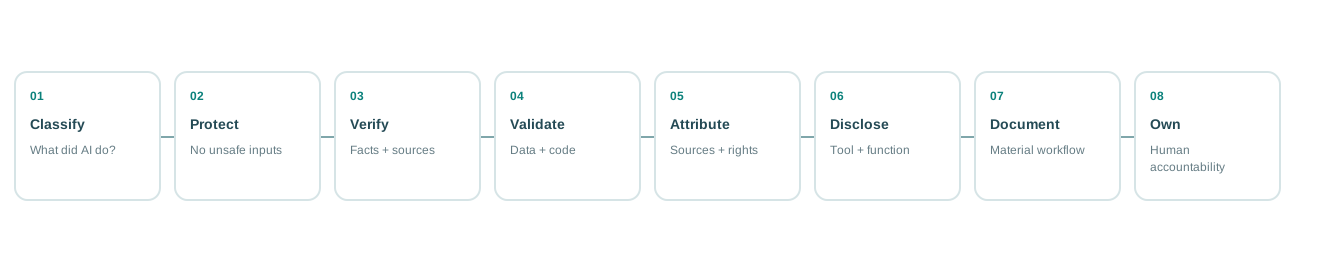
1. Purpose: AI Assistance Does Not Transfer Responsibility
AI-assisted technologies can support scholarly work, but they do not assume authorship, accountability or scientific responsibility. Human authors remain responsible for the accuracy, integrity, originality, attribution, ethics and reproducibility of everything submitted to a journal, including material drafted, transformed, analyzed or generated with AI assistance.
Treata therefore evaluates AI use by function and risk rather than treating all uses as equivalent. A spelling correction is fundamentally different from generating a literature synthesis, writing analysis code, classifying clinical data or creating an image. The more an AI system influences scientific content, evidence, interpretation or presentation, the stronger the need for verification, documentation and disclosure.
Authors should be able to explain what tool was used, what task it performed, what human verification occurred and whether confidential or protected information was exposed. “The AI produced it” is never an acceptable explanation for an error in a submitted work.
2. AI Cannot Be an Author or Accountable Contributor
AI systems cannot approve a final manuscript, accept responsibility for its integrity, respond to allegations, disclose competing interests or hold legal and ethical accountability. They therefore cannot satisfy authorship requirements and must not be listed as authors or co-authors.
Human authors must take responsibility for AI-assisted text, code, analyses, figures and other outputs as though they had produced those materials through other tools. This includes checking factual claims, citations, permissions, statistical validity, originality and consistency with the underlying data.
Using AI does not reduce the responsibilities attached to authorship. It can instead increase the verification burden because fluent output may conceal factual errors, fabricated references, inappropriate transformations or unrecognized bias.
3. Classify the AI Use Before Deciding What to Do
Treata distinguishes low-impact language assistance from substantive content generation and research-function use. Low-impact assistance can include spelling, grammar, formatting or stylistic refinement that does not introduce new intellectual or scientific content. Substantive use includes drafting arguments, synthesizing literature, generating interpretations, producing code, analyzing data, creating figures or transforming research materials.
Classification should be based on what the tool actually did, not on its marketing label. A general-purpose chatbot used only for grammar has a different risk profile from the same chatbot asked to infer missing clinical information or write a Discussion section.
When use crosses categories, apply the safeguards appropriate to the highest-risk function. Authors should not describe substantive generation as “language editing” merely because the final output was later revised by a human.
4. Writing, Rewriting and Language Editing
AI can assist authors who are improving grammar, clarity, readability or language fluency, including authors writing outside their primary language. Such assistance does not remove the need for authors to ensure that the final wording accurately represents their intended meaning and scientific claims.
When AI drafts new substantive text, the risk changes. Generated prose may introduce claims that were never supported by the study, alter causal language, exaggerate novelty, omit limitations or reproduce unattributed material. Authors should compare generated text against the source evidence rather than reviewing only for style.
Treata journals may distinguish routine spelling or grammar tools from generative writing assistance in their disclosure requirements. Authors should follow the target journal’s current instructions and should disclose substantive AI writing assistance transparently.
5. Literature Search, Screening and Evidence Synthesis
AI-assisted literature discovery can be useful for identifying concepts, expanding search terms or triaging large result sets, but a generative model should not be treated as an authoritative bibliographic database. It may omit important evidence, invent publications, merge details from different papers or privilege sources represented in its training or retrieval environment.
For systematic or structured evidence reviews, authors should preserve a reproducible search strategy using appropriate bibliographic databases and document any AI-supported screening or classification method. Eligibility decisions that materially affect the evidence base require human oversight and validation.
An AI-generated summary of a paper is not a substitute for reading the underlying source when the claim matters to the manuscript. Authors should cite and verify the original source rather than citing an AI system as the evidentiary authority.
6. Hallucinated Citations and Source Verification
Fabricated or corrupted citations are a major publication risk. AI systems can generate plausible author names, article titles, journal names, DOIs, quotations and page numbers that do not correspond to real sources or that point to sources that do not support the stated claim.
Every citation introduced or modified through AI assistance should be verified against the original publication or an authoritative bibliographic record. Authors should confirm that the work exists, bibliographic details are correct, the cited source actually supports the sentence, and any quotation is exact and properly attributed.
Reference verification cannot be delegated back to the same model that generated the reference. A model’s confidence or repeated assertion does not establish bibliographic accuracy.
7. Translation and Multilingual Assistance
AI translation can help authors prepare manuscripts, abstracts, correspondence or supporting materials, but scientific translation requires more than lexical substitution. Terminology, negation, uncertainty, units, diagnostic labels and statistical interpretation can change meaning across languages.
Authors should verify translated scientific content against the source text, ideally with a qualified human reader when the stakes are high. Particular care is needed for participant-facing materials, consent documents, patient quotations and instruments whose validated wording matters.
Translation should not be used to conceal plagiarism or to create the appearance of original authorship from another source. Copyright, attribution and permission obligations remain applicable after translation.
8. Coding, Software and Computational Work
AI can generate, explain, debug or refactor code, but executable output can be wrong while appearing convincing. Generated scripts may contain silent logical errors, insecure practices, inappropriate defaults, undocumented package assumptions or methods that do not match the manuscript.
Authors should test AI-assisted code against known cases, inspect critical logic, document software and package versions, preserve the final executable code used for the study and ensure that the Methods accurately describe what the code actually performed.
When AI materially contributes to research code or computational workflows, authors should disclose the use according to journal policy and provide enough methodological information for scientific scrutiny. Proprietary AI assistance does not excuse an unreproducible analysis.
9. Statistical Analysis and Quantitative Reasoning
AI-generated statistical advice should not be accepted solely because it is expressed fluently. Models can recommend inappropriate tests, misunderstand repeated measures, mishandle missing data, ignore multiplicity, confuse prediction with inference or interpret statistical significance as clinical importance.
Authors remain responsible for prespecification, model choice, assumptions, diagnostics, effect estimates, uncertainty and interpretation. AI-assisted analysis should be independently checked by a person with appropriate methodological competence and, where feasible, validated through reproducible code.
If an AI system directly performed or materially shaped the analysis, that role belongs in the Methods. The disclosure should be specific enough for readers to understand the tool’s scientific function rather than merely stating that “AI was used.”
10. Data Cleaning, Classification and Annotation
AI systems can classify records, extract variables, code qualitative material, identify images or assist with data cleaning. These uses can directly affect the dataset and therefore require validation appropriate to the research question.
Authors should define how outputs were checked, what reference standard was used, how errors were handled and whether performance differed across relevant subgroups. Automated transformations should be preserved in reproducible workflows rather than performed as undocumented manual interactions.
When an AI-generated label becomes research data, the manuscript should distinguish machine-generated values from directly observed measurements and describe human adjudication where applicable.
11. AI in Qualitative Research
AI may assist with transcription, coding, clustering or summarization of qualitative material, but these functions can strip context, flatten ambiguity or impose categories not grounded in participants’ accounts. Researchers should consider whether use is compatible with the epistemological approach and approved ethics framework.
Uploading interview transcripts, field notes or other qualitative data can expose highly sensitive information even after obvious identifiers are removed. Confidentiality and participant expectations should be evaluated before any external AI processing.
If AI contributed to coding or interpretation, authors should describe its role, human oversight and validation. A generative summary should not be presented as though it were an independently derived participant theme.
12. Images, Figures and Generative Visual Content
AI-assisted image creation and alteration require particular caution because visual outputs can change the evidentiary meaning of scientific material. Generative tools must not fabricate experimental observations, add or remove features from research images, or create a misleading representation of source data.
Routine figure layout, accessibility support or non-evidentiary illustration may be treated differently from manipulation of microscopy, radiology, pathology, gels or other primary scientific images. Authors should follow both the journal’s AI policy and Treata’s Image Integrity & Manipulation Policy.
When AI-generated illustrative content is permitted, label and disclose it as required and verify that it does not falsely imply empirical observation. Copyright, likeness, privacy and third-party rights remain relevant.
13. Generative Tables, Diagrams and Structured Content
AI can transform text into tables, flow diagrams or structured summaries, but transformation can introduce omissions, duplicate categories, change numerical values or imply relationships not present in the source.
Authors should compare generated structures line by line against the underlying evidence. Numerical tables require reconciliation with analysis outputs, and diagrams representing study design or causal relationships require scientific review.
A visually polished output should never receive less scrutiny simply because it appears organized. Presentation quality is not evidence of factual validity.
14. Confidentiality, Privacy and Data Protection
Do not upload confidential, privileged, identifiable or restricted material into an AI service unless its use is authorized and the data-handling conditions satisfy the applicable ethical, legal, contractual and institutional requirements. This includes participant data, unpublished collaborator data, confidential commercial information and restricted datasets.
Removing names may not adequately de-identify clinical, genomic, imaging or qualitative data. Prompts themselves can contain sensitive information, and service providers may process or retain inputs under terms that differ across products and account types.
Before using an AI system with research data, authors should understand where data are processed, whether inputs are retained, whether they may be used for model improvement, who can access them and whether institutional approval is required.
15. Submitted Manuscripts and Peer-Review Material
Submitted manuscripts and peer-review materials are privileged communications. Authors should not upload confidential reviewer reports, editorial correspondence or another researcher’s unpublished manuscript into an external AI system when confidentiality cannot be assured.
The same principle applies when authors are themselves reviewers for another journal. Current ICMJE guidance states that reviewers must follow the journal’s AI policy or seek permission and must protect manuscript confidentiality. Some organizations impose stricter prohibitions; for example, NIH prohibits generative AI use for analyzing and formulating critiques in its peer-review process.
An author revising a manuscript may use their own text subject to journal policy, but confidential reviewer comments remain editorial material and should not be exposed to an unauthorized service merely to generate a response letter.
16. Prompts, Outputs and Reproducibility
For substantive scientific uses, authors should preserve enough information to explain and, where feasible, reproduce what the AI system did. Relevant records can include tool name, provider, model or version, date of access, prompts or instructions, important settings, input preprocessing and human validation.
Exact reproducibility may be difficult because commercial models can change, outputs may be stochastic and proprietary systems may not expose model details. That limitation increases the importance of preserving the actual output used in the research and documenting subsequent human modifications.
Prompt disclosure should be proportionate. A journal may not need every grammar-editing prompt, while a prompt that generated analysis code or classified research observations can be methodologically important.
17. Verification: The Human Must Check the Evidence
Human verification should be matched to risk. Factual statements require source checking; citations require bibliographic verification; numerical outputs require reconciliation with data and code; translations require meaning checks; images require integrity review; and generated interpretations require comparison with the actual results.
Do not ask an AI system merely to verify its own prior output and treat agreement as independent confirmation. Verification should use primary sources, authoritative databases, reproducible computation or appropriately qualified human review.
Authors should document important corrections made after AI output when those corrections are part of the research workflow. A chain of unrecorded prompt-and-edit cycles can make substantive methods impossible to reconstruct.
18. Bias, Fairness and Generalizability
AI systems can reproduce or amplify biases in their training data, retrieval sources, labeling practices and model design. Performance can vary across languages, demographic groups, clinical settings and data distributions.
When AI is itself a research method or object of evaluation, authors should report relevant model characteristics, validation population, performance metrics, subgroup analyses and limitations. Claims of generalizability should not exceed the evidence.
Using a general-purpose AI assistant to summarize literature can also introduce selection bias. Authors remain responsible for seeking relevant counterevidence and representing uncertainty rather than accepting a generated consensus at face value.
19. Plagiarism, Attribution and Copyright
AI-generated text can resemble or reproduce source material without reliable attribution. Human authors are responsible for ensuring that submitted material is original or properly quoted, cited and licensed, regardless of how the AI system produced it.
Paraphrasing through AI does not erase the intellectual source of an idea. Authors should cite the underlying scholarship and should not use AI as a mechanism for disguising copied structure, arguments or wording.
For generated images, code and other outputs, authors should also consider applicable terms of service, copyright, licensing and third-party rights. A tool’s ability to generate content does not guarantee that every proposed use is legally or ethically appropriate.
20. Fabrication, Falsification and Synthetic Evidence
AI must not be used to invent participants, observations, experimental results, quotations, images, references or other evidence and present them as real. Synthetic data used for legitimate methodological purposes must be clearly identified as synthetic and described sufficiently to distinguish it from observed data.
Generating plausible missing values or participant responses is not an acceptable substitute for a justified statistical method. Likewise, creating illustrative clinical images and presenting them as actual cases would misrepresent the evidence.
If AI use results in fabricated or falsified content, the fact that the tool generated it does not remove human responsibility. Authors are accountable for what they submit.
21. Disclosure: What, Where and How Much
Current ICMJE recommendations call for authors to disclose AI-assisted technologies used in producing submitted work and to describe how they were used. Writing assistance may be reported in acknowledgments, while AI used for data collection, analysis or figure generation belongs in the Methods or other scientifically appropriate section; journals may also require disclosure in the cover letter or submission form.
A useful disclosure names the tool or system sufficiently to identify it, describes the task performed and explains substantive human oversight where relevant. “AI was used” is usually too vague for a research function, while pages of routine prompt history may be unnecessary for simple language correction.
Authors should follow the target journal’s current form and wording. Treata’s principle is functional transparency: disclose enough for editors and readers to understand whether AI affected language only, scientific content, data, analysis, code, images or interpretation.
22. When Disclosure May Be Minimal
Journals may treat conventional spelling, grammar or basic word-processing assistance differently from generative content creation. Current ICMJE editorial guidance notes that spelling and grammar correction is generally viewed as acceptable while content generation requires closer consideration.
Authors should not exploit this distinction by labeling substantive rewriting as grammar correction. If the tool generated new arguments, interpretations, citations, code, images or scientific text, the use is no longer merely mechanical.
Because journal policies evolve rapidly, authors should check the target journal’s instructions at the time of submission rather than relying on a disclosure rule remembered from an earlier manuscript.
23. AI Use in Cover Letters and Responses to Reviewers
AI may help authors organize a cover letter or revision response, but humans must ensure that the correspondence accurately describes changes made to the manuscript. A generated response should never claim that an analysis was performed, a paragraph was revised or a reviewer request was addressed when that action did not occur.
Reviewer comments and editorial correspondence may be confidential. Authors should not expose them to external AI systems unless permitted and confidentiality can be assured.
The final response letter should reflect the authors’ own scientific judgment. AI can assist with clarity and tone, but it should not be used to manufacture agreement, obscure disagreement or create false descriptions of revisions.
24. AI Use by Collaborators and Service Providers
Authors should consider AI use by statisticians, medical writers, translators, contract research organizations, image-processing services and other contributors, not only their own direct use. If a third party uses AI in a way that materially affects the manuscript or research, the author group still needs sufficient information to verify and disclose that use.
Contracts with service providers should address confidentiality, data handling, documentation and responsibility where AI processing may occur. Authors should not discover at submission that protected research data were uploaded to an external model without authorization.
The corresponding author should coordinate the disclosure record, but each contributor remains responsible for accurately describing their own relevant use.
25. AI Detection Tools Are Not Proof of Misconduct
Automated AI-content detectors can produce false positives and false negatives and should not be treated as definitive evidence that a manuscript was or was not AI-generated. Editorial assessment should focus on verifiable concerns such as fabricated references, inconsistent data, undisclosed methods, plagiarism or image manipulation.
Authors should not attempt to “beat” detectors through paraphrasing tools or deliberate obfuscation. The appropriate response to a disclosure requirement is transparency, not evasion.
If questioned about AI use, authors should provide a factual account of the tools and functions involved and, where relevant, preserved methodological records.
26. Post-Submission Discovery and Correction
If authors realize after submission that material AI use was omitted or inaccurately described, they should notify the journal promptly and provide a corrected disclosure. The editor can then determine whether additional methodological clarification, verification or review is needed.
After publication, a material omission may require a correction or other transparent update to the scholarly record. Current ICMJE guidance notes that nondisclosure can require corrective action and, in some circumstances, may be construed as misconduct.
Correction of an AI disclosure does not automatically mean the underlying research is invalid. The journal should separately assess whether the undisclosed use affected accuracy, originality, data integrity, confidentiality, analysis or conclusions.
27. A Practical AI Risk Test Before Submission
Before submitting, ask five questions. Did the AI see information it was not authorized to receive? Did it generate or transform scientific content rather than merely format language? Did its output affect data, code, images, analysis or conclusions? Can the authors independently verify the output? Has the use been disclosed at the level required by the journal?
Any “yes” to the first question requires immediate confidentiality review. A “yes” to substantive scientific influence increases the need for documentation, verification and disclosure. An inability to independently verify important output is a reason not to rely on it.
This risk test should be applied to the whole author group and relevant service providers, not only to the corresponding author’s personal workflow.
28. Treata AI Standard
Treata permits responsible use of AI-assisted technologies when use is compatible with journal policy, confidentiality, research ethics, data protection, intellectual-property obligations and scientific integrity. AI cannot be an author, and human authors remain fully accountable for all submitted content.
Substantive AI use should be transparently disclosed and described in the scientifically appropriate location. Authors must verify facts, citations, analyses, code, images and interpretations; protect confidential and participant information; preserve reproducibility records for material research uses; and correct significant omissions or errors.
Journal-specific settings may define prohibited uses, disclosure thresholds, required wording, acceptable tools or additional documentation. Those local requirements operate alongside Treata’s canonical Artificial Intelligence in Scholarly Publishing Policy (TS-AI-001).
Related author guidance
Connected author manuals
Canonical Treata standards