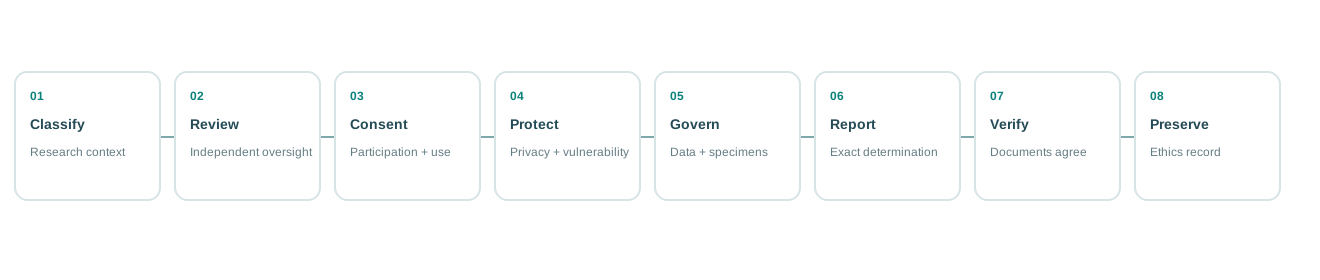
1. Start With the Ethical Status of the Research, Not With a Template Statement
Before writing an ethics paragraph, determine what the project actually is: prospective interventional research, observational human research, retrospective records research, secondary use of existing data or specimens, a case report, quality-improvement activity, clinical audit, research involving a biobank, or animal research. Ethical requirements depend on the nature of the activity, jurisdiction, institutional rules and the populations or materials involved.
Authors should not infer “no approval required” from study design alone. Retrospective research, secondary data analysis, quality improvement and case-based publications can still require ethics review, exemption, waiver, institutional determination or publication consent. The appropriate determination should come from the competent body when local rules require it.
The manuscript must describe the determination that actually occurred. Approval, exemption, waiver of review, waiver of consent and a finding that an activity is not human-participant research are different decisions and should never be reported as interchangeable labels.
2. Independent Ethics Review Is a Prospective Safeguard
For human research, authors should obtain review by an appropriate independent research ethics committee, institutional review board or equivalent body before research begins when such review is required. ICMJE’s current recommendations, updated January 2026, state that investigators should conduct human research in accordance with the 2024 Declaration of Helsinki and seek approval from an independent local, regional or national review body. The WMA identifies the 2024 Declaration as the current official version.
Ethics approval is not merely a publication document obtained after the work is complete. Its purpose is prospective protection: assessment of risk, consent, recruitment, privacy, data handling, vulnerable populations and other ethical features before participants are exposed to research procedures.
Authors should preserve approval letters, protocol identifiers, amendments and related determinations. Editors may request documentation, and approval by an ethics body does not prevent an editor from independently assessing whether the reported conduct appears ethically appropriate.
3. Approval, Exemption, Waiver and Non-Research Determinations
An ethics committee may approve a study, determine that it is exempt from specified review procedures, waive a particular requirement, or determine that an activity falls outside the applicable definition of research. Authors should use the exact determination and terminology supplied by the competent authority.
A waiver of informed consent does not mean that ethics review was waived. An exemption from full review does not mean that no ethical obligations exist. A retrospective design does not automatically create an exemption, and use of de-identified information does not by itself prove that institutional review is unnecessary.
Where no formal review was required under applicable rules, the manuscript should explain the basis accurately. Authors should not create retrospective approval numbers or imply committee review that never occurred simply because a submission system asks for an ethics field.
4. Informed Consent Is a Process of Voluntary Authorization
Informed consent is more than a signed form. Participants should receive understandable information about the research, its purposes, procedures, foreseeable risks and burdens, potential benefits, alternatives where relevant, data handling and the voluntary nature of participation, and should have a genuine opportunity to decide.
The 2024 Declaration of Helsinki requires freely given informed consent and recognizes formal documentation on paper or electronically, with witnessed and documented non-written consent where appropriate. It also emphasizes that refusal or withdrawal should not adversely affect ordinary care.
Authors should report how consent requirements were met without exposing participant identities. If consent was waived, state the waiver and the responsible authority rather than writing that consent was “not necessary” as an unsupported author conclusion.
5. Capacity, Assent and Legally Authorized Representatives
Some potential participants cannot provide fully informed consent because of age, temporary incapacity, cognitive impairment, unconsciousness or other circumstances. Ethical inclusion requires appropriate safeguards rather than automatic exclusion or automatic enrollment.
The 2024 Declaration of Helsinki requires consent from a legally authorized representative for participants incapable of free and informed consent and, when the person can provide assent, calls for that assent in addition to representative consent. Dissent should be respected. Inclusion should also be scientifically and ethically justified.
Authors should explain the relevant consent pathway in the manuscript when it is material to understanding the study. Avoid vague statements such as “consent was obtained from all participants” when different legal representatives, assent processes or emergency provisions were actually used.
6. Vulnerability Is Contextual and Requires Proportionate Protection
Vulnerability should not be reduced to a permanent label attached to a population. The 2024 Declaration of Helsinki recognizes that vulnerability may arise from fixed, contextual or dynamic factors and that both inappropriate inclusion and routine exclusion can cause harm.
Research involving people in situations of particular vulnerability should be responsive to their health needs and include protections proportionate to the risks, power relationships and practical circumstances. Examples can include children, people with impaired decision-making capacity, economically or educationally disadvantaged groups, institutionalized populations, people in dependent relationships and communities affected by emergencies or severe resource constraints.
Authors should explain why inclusion was scientifically justified and how additional safeguards were implemented where relevant, rather than merely listing a group as “vulnerable.”
7. Privacy, Confidentiality and Identifiability
Ethical approval does not eliminate the obligation to protect privacy. Collect only information justified by the research, limit access appropriately and consider whether combinations of apparently non-identifying variables could allow re-identification.
ICMJE’s current guidance states that identifying information should not be published unless it is essential for scientific purposes and written informed consent for publication has been obtained. It also notes that simply masking the eye region in a photograph is not adequate protection of anonymity.
Authors should distinguish anonymization from pseudonymization or coded data. If a key is retained or re-identification remains reasonably possible, describe the data accurately rather than calling them anonymous.
8. Research Consent and Publication Consent Are Different
Consent to participate in research does not automatically authorize publication of identifiable details, photographs, pedigrees, video, audio or distinctive clinical information. Publication can expose information to a global and durable audience, including online discovery.
ICMJE recommends written informed consent for publication when identifying information is essential and states that identifiable patients should be shown the material to be published, with awareness that identifiable material may be available online.
Case reports and clinical images deserve particular attention because combinations of age, diagnosis, timing, location and unusual circumstances can identify a person even when names are removed. When publication consent is required, authors should preserve appropriate documentation according to law and journal policy.
9. Retrospective Records Research Requires Real Ethical Analysis
A retrospective chart review is not ethically self-exempting. Existing clinical records were created for care, and secondary research use may raise questions about legal authority, consent, privacy, data minimization and access.
Authors should obtain the required ethics determination and accurately report whether consent was obtained or waived. If a waiver was granted, do not imply that the study had no consent considerations; report the waiver and approving body.
Data extraction should be limited to justified variables, performed by authorized personnel and protected throughout analysis. Publication should avoid combinations of details that create unnecessary re-identification risk.
10. Secondary Data, Registries and Publicly Accessible Information
Secondary analysis may involve research datasets, registries, administrative records, surveillance systems, public repositories or information available on the internet. “Publicly accessible” does not automatically mean ethically unrestricted.
Authors should consider the original consent or legal basis, data-use agreements, repository terms, sensitivity, reasonable participant expectations and the possibility of re-identification. Ethics review may still be required depending on jurisdiction and context.
When a dataset is controlled by a third party, report the source, access route and restrictions. Do not imply that authors obtained participant consent themselves when they relied on a lawful secondary-use framework.
11. Biobanks, Stored Specimens and Future Use
Research using stored biological material can raise issues beyond ordinary dataset reuse because specimens may support genetic, molecular or future analyses not anticipated at collection. Consent, governance, privacy and withdrawal mechanisms should therefore be considered together.
The 2024 Declaration of Helsinki states that consent should address collection, processing, storage and foreseeable secondary use of biological material and identifiable or re-identifiable data. For multiple or indefinite uses, it points to the governance principles of the Declaration of Taipei, and it requires ethics oversight of research databases and biobanks.
Where consent for secondary use is impossible or impracticable, the Declaration provides that such research may proceed only after consideration and approval by a research ethics committee. Authors should report the governance route actually used.
12. Genetic and Genomic Research Can Create Group-Level Risks
Genetic and genomic data may remain identifying even after direct identifiers are removed, and findings can have implications for relatives, ancestry groups or communities. Authors should avoid treating de-identification as a complete solution.
Consent and governance should address the intended analyses, data sharing, future use and clinically relevant return-of-results processes where applicable. Controlled access may be more appropriate than unrestricted public release for sensitive genomic datasets.
When research involves communities with distinctive cultural, social or collective interests, authors should consider whether engagement, benefit sharing or additional governance is warranted alongside individual consent.
13. Case Reports and Case Series Need a Publication-Focused Ethics Check
Case reports usually arise from clinical care rather than research designed to test a hypothesis, but publication can create substantial privacy risk. Authors should follow local institutional requirements for determining whether ethics review is required and should separately assess publication consent.
Remove nonessential identifying details, but do not alter clinical facts in a way that changes scientific meaning. Rare diagnoses, unusual timelines, recognizable images or detailed narratives can make a patient identifiable even without a name.
For case series that become systematic investigations, the boundary with research may change. Authors should seek institutional guidance rather than assuming that a larger collection remains exempt because individual cases began as clinical observations.
14. Clinical Trials Require Ethics Review and Registration as Separate Safeguards
Ethics approval and trial registration are complementary but different. Ethics review evaluates participant protection and protocol acceptability; registration creates a public record of planned trial features and supports transparency about outcomes and analyses.
Authors should report the ethics body, approval details, informed-consent process and trial registration information accurately. Registration should not be described as evidence of ethics approval.
Changes to outcomes, eligibility criteria, interventions or analyses should be reconciled with the protocol and registry. If a deviation occurred, explain it transparently rather than rewriting the manuscript to make the final study appear identical to the original plan.
15. Emergency and Critical-Care Research Requires Specific Safeguards
Emergency research can involve patients who lack capacity, time-sensitive interventions and situations in which a legally authorized representative is unavailable. These conditions create special ethical problems; they do not eliminate ethical review.
The 2024 Declaration of Helsinki permits research involving participants unable to consent in narrowly defined circumstances when that condition is necessary to the research group, the protocol states the reasons, and a research ethics committee has approved the approach. Consent should be sought from an authorized representative or from the participant as soon as appropriate when capacity returns.
Authors should clearly distinguish emergency clinical care from research procedures and report the approved consent pathway. Terms such as deferred consent, exception from informed consent or waiver should be used only when they accurately describe the applicable approved framework.
16. Disasters, Outbreaks and Public-Health Emergencies Do Not Suspend Ethics
Urgency can increase the social value of research, but it can also increase vulnerability, uncertainty and pressure on participants and health systems. Ethical safeguards should therefore be adapted to the emergency rather than abandoned.
Authors should document the ethics pathway, consent model, data governance and any justified protocol adaptations. Where public-health law authorizes data collection or surveillance without individual consent, distinguish that authority from research consent and from publication of identifiable information.
Rapid publication should not become a reason to bypass verification of ethics approval, participant protection or data provenance.
17. Children and Adolescents Require Age-Appropriate Participation
Pediatric research generally requires permission from a parent or legally authorized representative together with the child’s assent when the child is capable of meaningful involvement in the decision. Requirements vary by age, maturity, jurisdiction and study risk.
Authors should report the applicable process accurately and avoid treating parental permission as the only ethical consideration. Children should receive information appropriate to their understanding and their dissent should be respected where required.
Longitudinal studies may also need a plan for participants who reach legal adulthood during the research, particularly when continued data collection or specimen use is planned.
18. Pregnancy and Other Historically Excluded Populations
Routine exclusion can create evidence gaps that themselves cause harm. The 2024 Declaration of Helsinki’s approach to vulnerability emphasizes weighing harms of exclusion as well as inclusion.
For research involving pregnant participants or other populations historically excluded from studies, authors should be able to explain the scientific rationale, risk assessment and protections rather than relying on categorical assumptions.
Where fetal, reproductive or intergenerational risks are relevant, consent materials and monitoring should address those risks clearly and proportionately.
19. Dependent Relationships, Coercion and Undue Influence
Participants may feel unable to refuse when recruitment occurs through employers, teachers, treating clinicians, commanding authorities or other relationships involving dependency. Payment, access to care or academic consequences can also affect voluntariness.
The 2024 Declaration of Helsinki calls for particular caution in dependent relationships and provides that consent should be sought by an appropriately qualified individual independent of that relationship when coercion or duress is possible.
Authors should describe recruitment and consent safeguards when the context creates meaningful power imbalance. Compensation should reimburse or recognize participation without becoming an inappropriate inducement.
20. Withdrawal, Ongoing Consent and Return of Information
Consent is not necessarily a one-time event. Participants may withdraw from ongoing procedures, and research teams should explain what withdrawal means for data or specimens already collected, subject to law, protocol and scientific integrity.
The 2024 Declaration of Helsinki also states that participants should be given the option of being informed about the general outcome and results of the research. Studies should consider how important findings, incidental findings or study results will be managed when relevant.
Authors should avoid promising withdrawal or deletion rights that the study cannot lawfully or practically provide, particularly after anonymization or inclusion in completed analyses.
21. Data Sharing Must Remain Compatible With Consent and Governance
Open science does not override participant rights. Before depositing human research data, authors should verify that consent, ethics approval, privacy safeguards, data-use agreements and applicable law permit the proposed level of access.
Public sharing may be appropriate for sufficiently non-sensitive data; controlled access may be necessary for identifiable, re-identifiable, genomic or otherwise sensitive material. A Data Availability Statement should describe the real access pathway.
If data cannot ethically be shared publicly, say so transparently. Ethical restriction is preferable to false openness, and controlled access can still support legitimate reproducibility.
22. Cross-Border Data and Specimen Transfers
International research can involve transfer of data or biological material between institutions and legal jurisdictions. Authors should ensure that ethics approvals, consent, contracts and data-protection requirements support the transfer and intended downstream use.
A collaborator’s ability to technically receive a dataset does not establish lawful or ethical authority to transfer it. Material transfer agreements, data-use agreements and local governance may be required.
Manuscripts should report relevant international governance where it materially affects access, ownership, consent or interpretation.
23. AI and Automated Systems Applied to Participant Data
Use of AI does not create a separate ethical universe. If participant data, images, audio, genomic information or clinical records are processed through an AI system, the same consent, privacy, security, governance and purpose-limitation questions continue to apply.
Authors should understand whether an external tool stores prompts or data, uses them for model training, transfers them across jurisdictions or permits vendor access. Sensitive research data should not be uploaded merely because a tool is convenient.
When AI materially affects analysis, classification, prediction or interpretation, describe the method sufficiently for evaluation and preserve human responsibility for the scientific and ethical decisions.
24. Animal Research: Ethics, Welfare and the 3Rs
Animal research should be scientifically justified, ethically reviewed under applicable institutional and national frameworks, and designed to reduce avoidable harm. Authors should report the relevant oversight body and approval or license information where applicable.
The principles of Replacement, Reduction and Refinement should inform study planning: use alternatives where suitable, avoid unnecessary animal use while preserving scientific validity, and refine procedures to minimize pain, distress and lasting harm.
Humane endpoints, anesthesia, analgesia, housing, husbandry and monitoring should be reported when relevant. Ethical treatment and rigorous design are connected: poorly designed animal research can expose animals to harm without producing reliable knowledge.
25. ARRIVE 2.0 Is a Reporting Framework, Not an Ethics Approval
ARRIVE 2.0 organizes animal-research reporting into the Essential 10 and a Recommended Set. The Essential 10 are the minimum information needed for readers and reviewers to assess reliability, while the Recommended Set adds important context. ARRIVE also provides author checklists that some journals request at submission.
The guidelines cover study design, sample size, inclusion/exclusion, randomization, blinding, outcomes, statistics, experimental animals, procedures and results, with additional contextual items including the ethical statement.
Completing ARRIVE does not substitute for animal ethics review. Authors should satisfy both the ethical oversight requirements and the reporting requirements applicable to the work.
26. Write the Ethics Statement as a Verifiable Record
A useful ethics statement identifies what was reviewed, by whom and under what determination. Depending on the study, it may include the committee or authority name, approval or protocol number, consent status, waiver or exemption, trial registration and publication consent.
Avoid generic phrases such as “all ethical standards were followed” when more precise information is available. Equally, do not disclose participant identities or confidential committee material unnecessarily.
The ethics statement should agree with the Methods, title page, submission-system answers, registration, protocol and supplementary files. Contradictions across these records are a reason to stop and reconcile the submission.
27. When No Ethics Approval Was Required
Some activities may legitimately fall outside formal ethics-review requirements, but authors should not make that determination casually. Where local rules provide for an institutional determination, obtain and preserve it.
Report the basis clearly—for example, a competent body determined that the activity was not human-participant research or qualified for a specified exemption. Do not convert “we did not seek review” into “approval was not required” without support.
Editors may still ask whether the conduct and publication are ethically acceptable even when formal approval was not required. Publication ethics and institutional review are related but not identical judgments.
28. Ethics Irregularities Are Stop Conditions
Do not submit while a required ethics approval cannot be verified, a consent statement appears false, an approval identifier is fabricated, a protocol was materially altered without required oversight, identifiable information lacks necessary publication consent, or data/specimen use exceeds the authorized scope.
If an irregularity is discovered, preserve the records and seek guidance from the responsible ethics body or institution. Do not retrospectively rewrite documents to create the appearance of prospective approval.
During peer review or after publication, respond transparently to journal questions. Depending on severity, unresolved ethics concerns can affect editorial decisions or require correction, Expression of Concern or retraction.
29. The Final Ethics and Consent Audit
Before submission, reconcile the ethics approval, protocol, consent documents, trial registry, data-management plan, manuscript, Data Availability Statement, figures and supplementary files. Verify committee names, identifiers, dates and waiver language against source documentation.
Confirm that publication consent has been addressed separately where identifiable information is present. Check that data sharing does not exceed the consent or governance framework and that animal research reporting satisfies applicable ARRIVE requirements.
The corresponding author should know where supporting documentation is stored and who can respond if the journal requests verification.
30. Treata Ethics & Consent Standard
Treata expects authors to identify the ethical category of the work, obtain the required prospective oversight, protect autonomy and privacy, report consent and waivers accurately, and preserve documentation sufficient for editorial verification.
Human research should be reported with reference to the current Declaration of Helsinki and applicable local requirements; animal research should follow applicable welfare oversight and appropriate reporting guidance such as ARRIVE 2.0. Journal-specific instructions may add forms or declarations but do not reduce these core responsibilities.
When uncertainty exists, authors should seek a competent ethics determination before proceeding. Treata’s publication process cannot retroactively create ethical authorization that the research itself did not have.
Connected author manuals
Related author guidance
Canonical Treata standards