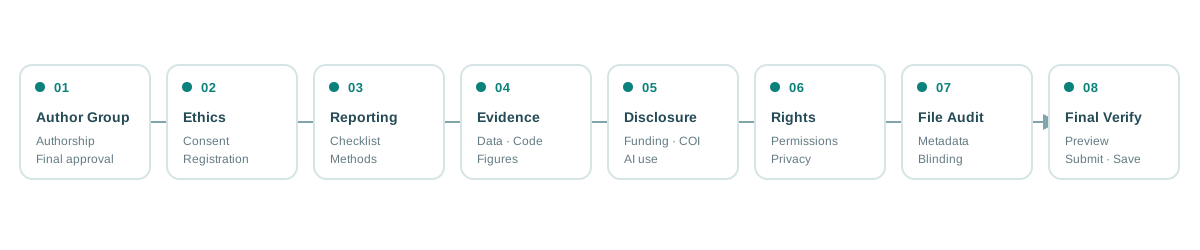
1. What Pre-Submission Readiness Means
Pre-submission review is the final controlled assessment of a manuscript before it enters an editorial system. Its purpose is not merely to satisfy formatting rules. It is the point at which the author group confirms that the research can be submitted truthfully, that required records exist, that the manuscript and metadata agree, and that no unresolved ethical, authorship, legal, financial, or reporting issue is being transferred unnecessarily to the journal.
A manuscript can be scientifically interesting and still be unready for submission. Missing ethics documentation, unresolved authorship, inaccurate registration, unavailable source data, uncertain permissions, inconsistent disclosures, or an incomplete reporting checklist can delay assessment or create more serious concerns later.
Use this manual after selecting the target journal and before pressing the final Submit button. For complex studies, begin the checks earlier because some problems cannot be repaired at the upload stage.
2. Freeze the Intended Submission Version
Create a clearly identified candidate submission version before the final review. Avoid having several co-authors independently editing different copies during the readiness check. Use a controlled filename, date or version number, and a single location for the authoritative manuscript.
Confirm which files belong to that version: title page, main manuscript, figures, tables, supplements, reporting checklists, cover letter, response documents where applicable, and supporting declarations.
Do not silently replace a file after co-author approval with a materially different version. If substantive changes are made, circulate the revised material to the authors whose approval is required.
3. Confirm the Target Journal and Article Type
Recheck the exact journal and article category. Authors sometimes prepare for one journal and later submit to another without revisiting requirements. This can leave the manuscript with the wrong structure, declarations, license assumptions, word limits, or reporting documents.
Read the current Instructions for Authors rather than relying on an old downloaded copy. Record any journal-specific requirements that differ from publisher-wide guidance.
Confirm that the article type accurately represents the work. Do not use a category to evade scientific, ethical, registration, or reporting obligations that arise from the underlying study.
4. Assemble the Final Author Group
Before submission, determine who qualifies for authorship and ensure that every listed author knows the manuscript is being submitted. Resolve order, corresponding-author designation, names, degrees where requested, affiliations, email addresses, and identifiers such as ORCID.
For biomedical journals applying ICMJE-style criteria, authorship normally requires substantial contribution, drafting or critical intellectual revision, final approval, and accountability. Contribution taxonomies such as CRediT can describe roles but do not independently establish authorship eligibility.
Do not add honorary, guest, gift, purchased, or coerced authors. Do not omit a contributor who qualifies in order to conceal involvement. Contributors who do not meet authorship criteria may be acknowledged when appropriate and with any consent required by the journal.
5. Obtain Final Author Approval
Every author should have an opportunity to review the version being submitted and approve it as required by the applicable authorship standard. Approval should be meaningful rather than assumed from silence where explicit approval is expected.
Authors should also know the target journal, the corresponding author, material funding and competing-interest declarations, and any important data or publication restrictions.
Keep an appropriate record of approval. The journal may use its own electronic confirmation workflow, but internal author-group documentation can be valuable when questions arise.
6. Prepare the Contribution Statement
Prepare an accurate contribution statement using the journal’s required format. If CRediT is requested, assign roles based on actual contributions rather than seniority or title.
Check that the contribution statement is compatible with the author list and manuscript. A person described as performing no substantive role may prompt a legitimate authorship question, while a major contributor omitted from both authorship and acknowledgements may require clarification.
Contribution statements should not be used to transfer all responsibility for the article to one author. They improve transparency about roles while authorship still carries broader accountability.
7. Resolve Authorship Changes Before Submission
If the author list changed during drafting, document why. Changes are easier to resolve before submission than after editorial assessment has begun.
Discuss disagreements within the author group or relevant institution rather than asking a journal editor to determine who deserves authorship. Editors can enforce policy and request documentation but usually cannot adjudicate underlying contribution disputes.
If an unresolved authorship dispute materially affects who is entitled to submit the work, do not proceed merely to secure a submission date.
8. Verify Ethics Review Documentation
For research involving humans, identifiable human material or data, animals, or other activities requiring oversight, locate the actual approval, exemption, waiver, or determination before submission.
Confirm the name of the ethics body, approval or reference number where applicable, date, study title, principal investigator, approved protocol version, sites, and any conditions relevant to the manuscript. The wording in the manuscript and submission form should match the documentation.
Do not invent an approval number, describe retrospective approval as prospective, or self-declare an exemption when an appropriate authority was required to make that determination.
9. Check Protocol Amendments Against the Manuscript
Compare the conducted study and manuscript with the approved protocol and amendments. If important changes occurred in recruitment, outcomes, procedures, sites, sample size, analysis, or consent, confirm that required amendments or notifications were handled appropriately.
Not every methodological change is an ethics violation, but material differences should be understood and reported transparently when relevant.
If the manuscript describes procedures that are not covered by the documentation available to the authors, resolve the discrepancy before submission.
10. Confirm Informed Consent and Publication Consent
Distinguish consent to participate in research from consent to publish identifiable information. The latter can be required for case reports, photographs, videos, pedigrees, detailed narratives, or combinations of information from which an individual could reasonably be recognized.
Review figures, tables, supplements, imaging, dates, locations, occupations, rare conditions, family relationships, and free-text descriptions for direct and indirect identifiers.
Do not alter scientific facts deceptively to disguise identity. When potentially identifying information is scientifically necessary, follow the journal’s publication-consent and privacy requirements.
11. Check Special or Vulnerable Populations
Where research involves children, people with impaired decision-making capacity, dependent relationships, emergency settings, stigmatizing conditions, Indigenous or culturally governed data, or other contexts requiring additional safeguards, confirm that the manuscript accurately describes the relevant protections.
Consent terminology should match what actually occurred, including assent, proxy or legally authorized representative consent where applicable.
Do not use generic language such as 'all ethical requirements were followed' as a substitute for the specific information required by the journal.
12. Verify Clinical Trial Registration
For a clinical trial, verify the registry record directly before submission. Confirm registry name, identifier, registration date, recruitment status, intervention, eligibility, primary and secondary outcomes, and other material fields.
For journals following ICMJE clinical-trial requirements, prospective registration at or before enrollment of the first participant is expected. If registration was late, do not conceal the timing; explain it accurately and allow the journal to assess the circumstances.
Ensure that the registry identifier in the abstract, manuscript, metadata, and cover letter is identical.
13. Compare Registry, Protocol, SAP and Manuscript
Perform a cross-document comparison of the trial registry, protocol, statistical analysis plan where applicable, and manuscript. Look specifically for changes in primary outcomes, secondary outcomes, sample size, eligibility, analysis populations, subgroup analyses, stopping rules, and study dates.
Changes can be scientifically legitimate. The problem is unexplained selective reporting or presenting a post hoc decision as if it had been prespecified.
Where material changes occurred, describe them transparently in the manuscript or supporting documentation as appropriate.
14. Identify the Correct Reporting Guideline
Select the reporting guideline that corresponds to the study design rather than choosing the most familiar checklist. EQUATOR can help authors identify applicable frameworks.
Common health-research examples include CONSORT, STROBE, PRISMA, SPIRIT, STARD, TRIPOD, CARE, COREQ or SRQR, ARRIVE, SQUIRE, and CHEERS. Extensions may apply to specific interventions, data types, populations, or methods.
Use the current version required by the journal. A reporting checklist is not an administrative attachment; it is a structured audit of whether essential information appears in the manuscript.
15. Complete the Reporting Checklist Honestly
Work through every applicable item and provide accurate page, section, table, figure, or supplement references. Do not mark an item as reported when the information is absent.
If an item is not applicable, use the journal’s accepted notation and provide an explanation when useful. Do not use 'N/A' to avoid reporting an inconvenient methodological detail.
After completing the checklist, revise the manuscript to correct omissions and then update the checklist references. The checklist and manuscript should agree at submission.
16. Check the Title and Abstract
The title and abstract are often the most widely read parts of the article. Confirm that they identify the study accurately and do not overstate causality, novelty, generalizability, or clinical implications.
Include design information when required by the reporting guideline or journal. Check numerical results, sample sizes, confidence intervals, registry identifiers, and conclusions against the main text.
Remove promotional wording that is not supported by the study. The abstract should not contain a stronger conclusion than the article itself.
17. Audit the Methods for Reproducibility
Ask whether a qualified reader can understand what was done. Check study design, setting, dates, participants or materials, eligibility, sampling, interventions or exposures, outcomes, measurements, equipment or software, quality controls, and analytical procedures.
Report prespecified and exploratory analyses appropriately. Define variables and thresholds. Explain important transformations, exclusions, handling of repeated observations, clustering, matching, weighting, or model selection where relevant.
If essential methods exist only in an inaccessible protocol or previous article, provide enough information or an appropriate accessible reference to make the present work understandable.
18. Audit Statistical Reporting
Verify that the statistical methods correspond to the data and study design and that the manuscript distinguishes descriptive, inferential, exploratory, and confirmatory analyses where relevant.
Check denominators, units, effect estimates, measures of uncertainty, p-values where used, missing data, exclusions, multiplicity, subgroup analyses, model assumptions, sensitivity analyses, and software information required by the journal.
Ensure that numbers agree across abstract, text, tables, figures, supplements, and repository outputs. A final numerical consistency check can prevent many avoidable corrections.
19. Review Results for Selective Reporting
Compare reported outcomes with the protocol, registration, analysis plan, and data outputs. Confirm that unfavorable, null, adverse, or unexpected findings have not been omitted merely because they weaken the preferred narrative.
Check participant flow and denominators. Explain exclusions and missing observations. If analyses changed after seeing the data, label and interpret them appropriately rather than presenting them as prespecified.
Do not move inconvenient primary outcomes into supplementary material solely to reduce their visibility.
20. Calibrate the Discussion and Conclusions
Ensure that the discussion reflects the actual design and evidence. Observational associations should not automatically be described as causal effects, and small exploratory studies should not make population-wide claims without qualification.
State important limitations and uncertainty. Avoid claiming that a study is the 'first', 'largest', 'definitive', or 'proven' unless the statement can be supported responsibly.
Recommendations for practice, policy, or future research should be proportionate to the evidence.
21. Prepare the Data Availability Statement
Determine what data underlie the article, who controls them, what can legally and ethically be shared, where data are deposited, and what conditions apply to access.
A useful data availability statement tells readers whether data are openly available, available under controlled access, available on reasonable request where that model is justified, held by a third party, or restricted for a stated reason.
Do not promise open sharing if participant consent, privacy, law, contract, cultural governance, intellectual property, or third-party rights prevent it. Equally, do not use a vague restriction when data can appropriately be shared.
22. Prepare Data for Deposit or Editorial Verification
If public or controlled repository deposit is required, prepare files, metadata, documentation, data dictionaries, README material, licenses, and persistent identifiers where available.
Remove or manage identifiers appropriately. De-identification should be assessed in context because combinations of variables can re-identify participants.
Even when public sharing is restricted, maintain an organized underlying dataset that can support legitimate confidential editorial or integrity assessment subject to applicable protections.
23. Prepare Research Code and Computational Materials
Identify custom code, scripts, notebooks, models, configuration files, software versions, random seeds, dependencies, or computational workflows that materially affect the reported results.
Clean the repository without destroying provenance. Remove passwords, access tokens, confidential paths, personal identifiers, proprietary data, and files that the authors do not have rights to redistribute.
Test whether another qualified person can understand how the main results were generated. Where code cannot be public, state the reason and the access conditions accurately.
24. Document AI-Assisted Work
Review how AI-assisted technologies were used across writing, translation, coding, analysis, literature organization, image processing, or other parts of the project. Determine what must be disclosed under the target journal’s current policy.
AI cannot be an author. Human authors remain responsible for accuracy, originality, attribution, references, methods, confidentiality, and the final manuscript.
If AI was part of the research method, provide sufficient methodological information about the system, version or access date where relevant, inputs, configuration, validation, human oversight, and limitations for scientific evaluation.
25. Verify AI-Generated or AI-Assisted Content
Independently verify factual statements, citations, quotations, calculations, code, statistical interpretations, and summaries produced with AI assistance. Plausible wording is not evidence of accuracy.
Check every reference against the actual source. Fabricated or corrupted references are a preventable author responsibility issue.
Review whether any confidential participant data, unpublished third-party material, proprietary information, or restricted manuscript content was uploaded to an external AI service contrary to applicable obligations.
26. Complete Funding Information
Identify all organizations that financially or materially supported the research or manuscript and provide grant numbers or award identifiers where required.
Distinguish research funding from employment, equipment support, medical writing support, article-processing support, travel, consultancy, or other relationships that may require separate disclosure.
Ensure funding information is consistent across manuscript, submission metadata, acknowledgements, funder registry fields, and any required forms.
27. Describe the Sponsor’s Role
If a sponsor had a role in study design, data collection, data management, analysis, interpretation, manuscript preparation, approval, or the decision to submit, disclose that role as required.
Authors should know whether agreements restrict access to the complete data or the ability to publish results. ICMJE guidance emphasizes that authors should avoid agreements that interfere with access to data or independent publication.
If the sponsor had no role in specified activities and the journal requests such a statement, ensure that the statement is accurate rather than copied automatically from another paper.
28. Complete Competing-Interest Disclosures
Ask each author to review relevant financial and non-financial relationships under the target journal’s policy. Do not have the corresponding author guess on behalf of co-authors when individual disclosure is required.
Potential interests can include employment, consultancy, honoraria, equity, patents, advisory roles, paid expert testimony, professional leadership, close academic competition, personal relationships, or other circumstances relevant to the work.
Disclosure does not automatically imply bias. Its purpose is transparency. When uncertain whether a relationship is relevant, provide enough information for appropriate assessment rather than concealing it.
29. Check Related Manuscripts and Overlapping Publications
Identify manuscripts, preprints, conference reports, protocols, abstracts, datasets, theses, registry reports, or published articles that arise from the same study, cohort, experiment, or dataset.
Where overlap could affect editorial assessment, disclose the relationship and provide copies or citations as requested. Explain what is new in the submitted manuscript.
Do not submit the same manuscript simultaneously to multiple journals unless an explicitly authorized publishing model permits it. Do not divide one coherent study into minimally distinct publications merely to increase output.
30. Review Preprints and Prior Dissemination
Check the target journal’s current preprint policy. If a preprint exists, ensure the journal receives the identifier or link where requested and that the submitted manuscript’s relationship to the preprint is transparent.
Review conference presentations, media releases, institutional repositories, theses, reports, websites, and public datasets for prior dissemination relevant to the journal’s policy.
Prior dissemination is not automatically duplicate publication. The key is to disclose it accurately and follow the journal’s rules.
31. Secure Permissions for Third-Party Material
Review every figure, table, photograph, map, questionnaire, scale, screenshot, diagram, substantial excerpt, or other element that was not created entirely by the authors.
Determine whether the material is licensed for the intended reuse, whether permission is required, what credit line must appear, and whether the journal’s publication license is compatible with the permission.
Citation does not replace permission. Material found online is not automatically free to reuse. Keep copies of permission correspondence and license evidence.
32. Check Patient and Participant Images
Remove unnecessary identifying features from clinical photographs, radiology, microscopy labels, screenshots, forms, and other images. Check embedded labels as well as the visible image.
Cropping or masking does not always make an individual unidentifiable. If recognition remains reasonably possible, ensure appropriate publication consent exists.
Do not use cosmetic image alteration to conceal identity if the alteration changes scientifically relevant information.
33. Perform an Image-Integrity Audit
Locate original image files and ensure the submitted figures can be traced back to them. Review cropping, contrast, brightness, color adjustments, splicing, annotations, panel assembly, and duplicated elements.
Adjustments should not create, remove, move, obscure, or selectively enhance scientifically relevant features. If a composite is assembled from different fields, exposures, experiments, or images, present it transparently as required by the discipline.
Keep source files after publication according to appropriate research-record retention practices. Editors may request them when legitimate questions arise.
34. Audit Tables and Supplementary Files
Check every table for accurate labels, units, denominators, footnotes, abbreviations, totals, statistical annotations, and consistency with the text.
Treat supplementary material as part of the scholarly record. Apply the same standards for privacy, permissions, data accuracy, authorship, and integrity.
Open every supplementary file before submission. Verify that the correct version is included and that no hidden personal, confidential, or obsolete content remains.
35. Verify Every Reference
Confirm that each reference exists, is cited for an appropriate proposition, and contains accurate bibliographic information. Check authors, title, journal or source, year, volume, pages or article number, and DOI or other identifier where relevant.
Do not cite a source solely because an AI tool, search summary, or reference manager suggested it. Read enough of the original source to know that it supports the statement.
Check whether heavily relied-upon sources have been corrected, retracted, or otherwise updated. If citing retracted work for a legitimate reason, make the context clear.
36. Check for Citation Manipulation
Review the reference list for unnecessary self-citation, citation stacking, irrelevant citations added to satisfy a reviewer or editor, and references inserted primarily to influence metrics.
Relevant self-citation is legitimate. The problem is coercive or artificial citation behavior disconnected from the scholarly needs of the manuscript.
If a requested citation is not scientifically relevant, authors may explain this respectfully during editorial communication.
37. Prepare an Effective Cover Letter
A cover letter should identify the manuscript, explain its relevance to the journal succinctly, and provide information the editor genuinely needs. It should not be a marketing document filled with unsupported superlatives.
Where relevant, disclose related manuscripts, preprints, unusual authorship circumstances, prior editorial history requested by the journal, ethical complexities, or other information that cannot be understood from the manuscript alone.
Do not claim that the manuscript is 'guaranteed to be highly cited', 'the first ever' or 'certain to change practice' unless such statements can be justified. Never use the cover letter to pressure an editor.
38. Prepare for the Journal’s Blinding Model
If the journal uses blinded review, follow its specific anonymization instructions. Remove author names and affiliations from the blinded manuscript and inspect acknowledgements, contribution statements, file properties, tracked changes, comments, filenames, self-identifying repository links, and supplementary files.
Do not distort scholarship to hide identity. References to the authors’ previous work should generally be written in a normal scholarly manner unless the journal specifically instructs otherwise.
Perfect anonymity cannot always be guaranteed in specialized fields. The author’s responsibility is to follow the declared process in good faith.
39. Remove Hidden Metadata and Editing Debris
Inspect word-processing properties, PDF metadata, comments, tracked changes, hidden text, annotations, spreadsheet sheets, presentation notes, image metadata, and filenames for confidential or identifying information.
Accept or reject tracked changes as appropriate and remove internal comments that were not intended for editors or reviewers.
Do not strip scientifically important metadata from research data or images merely for cosmetic cleanliness; distinguish submission-file privacy from research provenance.
40. Verify Figures and Technical Files
Check file format, resolution, dimensions, fonts, labels, color mode, accessibility, and separate-file requirements against the journal’s instructions.
Ensure figure numbering and citations match the manuscript. Confirm that legends explain symbols, abbreviations, scale bars, error bars, statistical markers, and panel labels as needed.
Open the actual uploaded file rather than assuming the export succeeded. Conversion can alter fonts, transparency, line weights, equations, and image quality.
41. Check Units, Nomenclature and Terminology
Use discipline-appropriate units, gene or protein nomenclature, drug names, species names, anatomical terminology, statistical notation, and abbreviations consistently.
Define non-standard abbreviations at first use and avoid unnecessary abbreviations that make the article harder to read.
Check terminology involving people and populations for accuracy, respect, and consistency with current disciplinary guidance where applicable.
42. Check Language Without Altering Scientific Meaning
Language editing should improve clarity, not inflate claims or change technical meaning. Authors remain responsible for the final wording even when a professional editor, translation service, or AI tool was used.
Pay particular attention to negation, probability, statistical interpretation, causal language, and units because small language changes can alter scientific meaning.
Do not assume that polished English compensates for incomplete methods or reporting. Editorial clarity and scientific completeness are separate requirements.
43. Build the Submission File Set
Create a final folder containing only the files intended for submission. Use clear filenames and remove obsolete drafts to reduce upload errors.
Depending on the journal, the package may include title page, blinded manuscript, unblinded manuscript, figures, tables, supplements, reporting checklist, cover letter, graphical abstract, highlights, data files, permissions, ethics documentation, or other article-specific material.
Do not upload confidential ethics or consent documents unless the journal requests them through an appropriate route. Keep sensitive records ready for legitimate verification without making them unnecessarily public.
44. Match Submission Metadata to the Manuscript
Information entered into the submission system should match the approved manuscript: title, short title, abstract, keywords, authors, order, affiliations, corresponding author, funding, conflicts, registration, data availability, and article type.
Copying metadata from an old submission is a common source of errors. Verify each field rather than assuming the system populated it correctly.
If the platform uses author email confirmation, ensure addresses are current and controlled by the relevant authors.
45. Review Suggested and Opposed Reviewers Carefully
If the journal permits reviewer suggestions, recommend people with appropriate expertise and disclose or avoid relationships that could compromise independence under the journal’s rules.
Never fabricate reviewer identities or email addresses, impersonate reviewers, create false accounts, or suggest reviewers as part of an arrangement to manipulate peer review.
If the journal permits requests to exclude reviewers, provide a concise legitimate reason. The editor retains responsibility for reviewer selection.
46. Complete Submission Declarations Truthfully
Submission systems often require declarations concerning originality, simultaneous submission, author approval, conflicts, funding, ethics, consent, registration, data, AI, copyright, and permissions.
Read each declaration. Do not click through automatically. A checkbox can constitute a formal representation to the journal.
If a declaration does not fit the circumstances, seek clarification rather than selecting an inaccurate answer merely to advance the submission.
47. Generate and Inspect the Submission PDF
Many systems compile uploaded files into a review PDF. Open the generated document from beginning to end before approval.
Check title, abstract, equations, symbols, page breaks, figures, tables, supplementary links, special characters, blinded information, and file order. Confirm that no figure or page is missing.
A correct source file can still be rendered incorrectly by a submission platform. The final preview is therefore an independent quality-control step.
48. Run a Cross-Document Consistency Audit
Compare manuscript, abstract, tables, figures, supplements, registry, protocol, reporting checklist, data statement, cover letter, and submission metadata for contradictions.
High-value fields include sample size, dates, outcome definitions, author list, affiliations, funding, ethics approval, registration number, trial status, numerical results, and repository identifiers.
Resolve inconsistencies rather than assuming an editor will know which version is correct.
49. Run the Final Integrity Check
Ask whether any information has been fabricated, falsified, selectively concealed, deceptively manipulated, plagiarized, duplicated without disclosure, or presented in a way that could mislead editors or readers.
Confirm that source data and images can be located, major claims are supported, references are real, permissions are documented, and author identities and contributions are genuine.
If a serious concern is discovered at this stage, delay submission and resolve it. A submission deadline does not justify knowingly sending an unreliable record.
50. Run the Final Compliance Check
Confirm compliance with the target journal’s scope, article type, formatting essentials, reporting requirements, ethics documentation, registration, data and code policy, AI policy, authorship rules, conflict disclosures, rights and permissions, access model, and fees.
Where a requirement is genuinely not applicable, make that clear. Where compliance is impossible because of a legitimate restriction, determine whether the journal permits an exception and how it must be documented.
Do not rely on compliance with a different Treata journal. Journal-specific settings can differ.
51. Obtain the Author Group’s Submission Go-Ahead
Before the corresponding author submits, communicate that the final package is ready and identify any material changes made during the final audit.
Confirm that no author has raised an unresolved objection about authorship, data accuracy, ethics, interpretation, conflicts, or the target journal.
The corresponding author coordinates the submission but should not use that role to bypass co-author accountability.
52. Submit and Preserve the Record
After submission, save the manuscript identifier, timestamp, exact submitted files, generated PDF, declarations, cover letter, reporting checklist, and any immediate system correspondence.
Do not continue editing the local 'submitted version' without creating a new version. Preserve the record of what the journal actually received.
If the submission system reports an error or incomplete status, verify that the manuscript is formally submitted rather than assuming an upload equals submission.
53. Respond to Immediate Technical Queries
Editorial offices may request missing files, corrected metadata, higher-resolution figures, declarations, ethics information, or other technical corrections before scientific assessment.
Respond accurately and promptly. Do not treat a technical request as permission to make undisclosed substantive changes to the manuscript.
If a requested correction reveals a deeper problem—for example, a missing approval, incorrect author list, or false data statement—address the underlying issue rather than merely changing the form.
54. Pre-Submission Stop Conditions
Do not submit when a material issue remains unresolved concerning authorship entitlement, data reliability, required ethics approval, publication consent, trial registration representation, fabricated or unverifiable references, rights to essential material, or a known serious conflict between the manuscript and underlying records.
Also stop if the author group has not approved the manuscript as required, the same manuscript is actively under consideration elsewhere contrary to policy, or the submission requires a declaration you know to be false.
A temporary delay is preferable to creating a preventable integrity case after submission.
55. The 60-Second Final Verification
Immediately before clicking Submit, confirm: correct journal; correct article type; correct manuscript version; correct author list and order; all authors approved; ethics and consent accurate; registration accurate; reporting checklist complete; data and code statements accurate; AI use addressed; funding and conflicts complete; related work disclosed; permissions secured; figures and references verified; blinding correct; metadata matches; fees and license conditions understood.
Then open the generated preview one final time. If anything appears different from the approved package, correct it before submission.
This short check does not replace the detailed manual. It is the final barrier against preventable upload and declaration errors.
56. Treata Policy and Journal Configuration
Treata separates publisher-level requirements from journal-specific settings. Master Publishing Policies govern areas such as publication ethics, authorship, conflicts, peer review, research ethics, data, AI, rights, and record correction. Individual journals configure operational requirements such as article types, formatting, review model, data profile, license, fees, and submission files.
Authors should therefore consult both layers. A Treata-wide guideline should not be interpreted as evidence that every Treata journal has identical APCs, licenses, word limits, reporting files, or technical submission requirements.
When a journal instruction appears inconsistent with a canonical Master Policy, seek clarification before making a declaration or relying on the conflicting instruction.
Continue preparing
Related Author Guides
Canonical standards
Related Treata Master Policies
This manual explains practical preparation. Canonical Master Policies define the governing publisher requirements.