1. What a Reporting Guideline Is
A reporting guideline is a structured tool—often a checklist, flow diagram or structured text—designed to identify the minimum information readers need to understand and use a specific type of research. It improves transparency of reporting; it does not itself guarantee that the study was well designed or conducted.
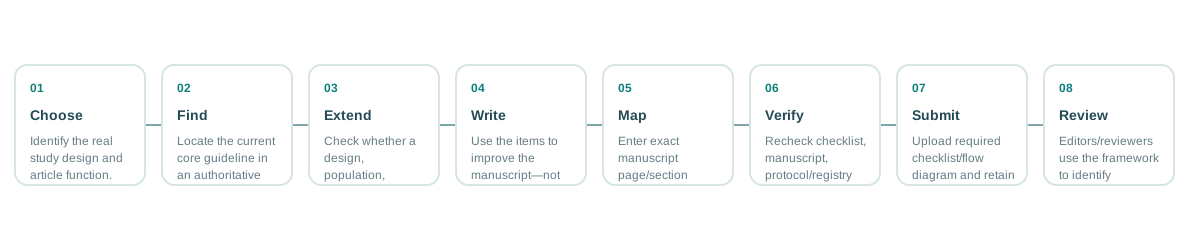
2. Select by Study Design, Not by Article Label
Start with what the study actually did. An 'Original Article' could be a randomized trial, cohort study, diagnostic-accuracy study, prediction-model study or qualitative investigation, each requiring different reporting guidance.
3. Use the Guideline While Writing
Do not wait until the submission portal asks for a checklist. Apply the guideline during manuscript preparation so missing methods, outcomes, flow information and declarations can be corrected in the article itself.
4. Reporting Is Not Methodological Quality Scoring
A manuscript can report a weak method completely, and a strong study can be reported incompletely. Editors and reviewers should not use checklist completion as a numerical quality score.
5. Core Guideline Plus Extension
Many research designs require both a core guideline and one or more extensions. Extensions may address special designs, interventions, populations, data sources, abstracts or methodological features.
6. Multiple Guidelines May Legitimately Apply
A trial with an economic evaluation may need CONSORT plus CHEERS; an observational study using routinely collected health data may need STROBE plus RECORD; an intervention report may use its design guideline plus TIDieR.
7. Use the Current Applicable Version
Reporting standards evolve. Authors should check the official guideline source and the target journal’s current instructions rather than relying on an old checklist saved from a previous submission.
8. Journal-Specific Requirements Still Apply
A Treata journal may require particular checklists, flow diagrams, protocol files, page-number mapping or extensions. Publisher-level guidance does not imply that every journal has identical submission requirements.
How to Decide Between Similar Guidelines
When two frameworks appear plausible, define the research question, unit of analysis, study design and principal inferential goal. Diagnostic accuracy, prediction, prognosis and causal-effect studies can use similar datasets but require different reporting. When necessary, document why a particular guideline was selected.
How to Find an Extension
After selecting the core guideline, search for extensions by design, population, intervention, data source, clinical area or report component. Examples include abstracts, cluster trials, pragmatic trials, scoping reviews, literature searches and routinely collected data. An extension supplements the core unless its documentation explicitly states otherwise.
How to Complete a Checklist
Work item by item. For each applicable item, identify the exact page, paragraph, table, figure or supplement where it is reported. If an item is genuinely not applicable, use the journal’s accepted notation and explain when useful. Never enter a page number for information that is not actually present.
Do Not Treat 'N/A' as an Escape Route
Not applicable should mean the item does not apply to the design or circumstances. It should not be used because the information is unavailable, inconvenient, unfavorable or omitted from the study.
Page Numbers and Section Mapping
Complete the checklist against the final submission version. Late editing can change pagination and section locations, so recheck mappings after generating the final manuscript PDF.
Flow Diagrams
When a framework includes a flow diagram, ensure counts reconcile with the Results and tables. Trial participant flow and systematic-review study-selection flow are not decorative graphics; they document inclusion, exclusion and analysis pathways.
Checklist and Manuscript Must Agree
The checklist is an index to the manuscript, not a parallel version of the research record. Sample sizes, dates, outcomes, registration, analyses and other facts must remain consistent across both.
Protocol and Registration Cross-Check
For registered or protocol-driven research, compare the reporting checklist with the protocol, registry and statistical analysis plan. Reporting completeness should not conceal unexplained deviations from prespecified methods.
Abstract-Specific Guidance
Some reporting frameworks include dedicated abstract checklists or extensions. Because abstracts are frequently read without the full article, authors should report essential design and result information rather than using the abstract as promotional copy.
Reporting Interventions Completely
Even a correctly reported trial may be difficult to replicate if the intervention is poorly described. Companion frameworks such as TIDieR can provide additional structure for intervention content, delivery, dose, tailoring and fidelity.
Reporting AI and Machine-Learning Research
AI or machine-learning studies may require both a core design framework and specialized reporting guidance or extensions. Authors should report data provenance, preprocessing, model development, validation, performance, human oversight and limitations at a level appropriate to the scientific claim.
Reporting Routinely Collected and Real-World Data
Administrative, registry, electronic-health-record and other routinely collected data require transparent reporting of source systems, coding, linkage, coverage, access, missingness and selection mechanisms. Extensions such as RECORD may supplement STROBE.
Reporting Mixed-Methods Research
Mixed-methods studies should make the quantitative and qualitative components, integration strategy and rationale clear. Apply component-specific reporting guidance where appropriate without creating contradictory duplicate descriptions.
Reporting Secondary and Subgroup Analyses
Secondary analyses should identify the parent dataset/study, original purpose, new question, selection of analytic sample and whether analyses were prespecified. Relevant reporting guidance follows the design of the secondary analysis as well as the provenance of the data.
Reporting Negative or Inconclusive Results
Reporting standards apply regardless of direction or statistical significance. Null or inconclusive findings still require complete methods, outcomes, uncertainty and limitations; selective omission undermines the research record.
Reporting Guidelines and Ethics
A checklist does not substitute for ethics approval, consent, trial registration, animal oversight, data governance or privacy protection. These are separate obligations that may also be items within a reporting framework.
Reporting Guidelines and Peer Review
Treata journals may use reporting guidelines during initial assessment and peer review to identify missing information. Editors and reviewers should request reporting necessary to evaluate the work while avoiding mechanical demands for irrelevant checklist items.
What Treata May Require at Submission
Depending on journal and article type, the submission system may request the guideline name, completed checklist, flow diagram, protocol or registry identifier, supplementary reporting files and confirmation that applicable extensions were considered.
What Happens When Reporting Is Incomplete
A manuscript may be returned for technical correction, queried during editorial assessment, or asked to address omissions during peer review. Severe or systematic discrepancies between checklist claims and the manuscript can also raise broader integrity questions.
Treata Reporting Standards Rule
Authors should identify and use the most appropriate current reporting guidance for their study design, apply relevant extensions, complete required checklists accurately, and ensure all checklist claims correspond to the submitted manuscript. Journal-specific instructions determine which reporting files are mandatory.
Related author guidance
Use reporting standards across preparation
Treata standards