1. Use This Manual with the Journal Instructions
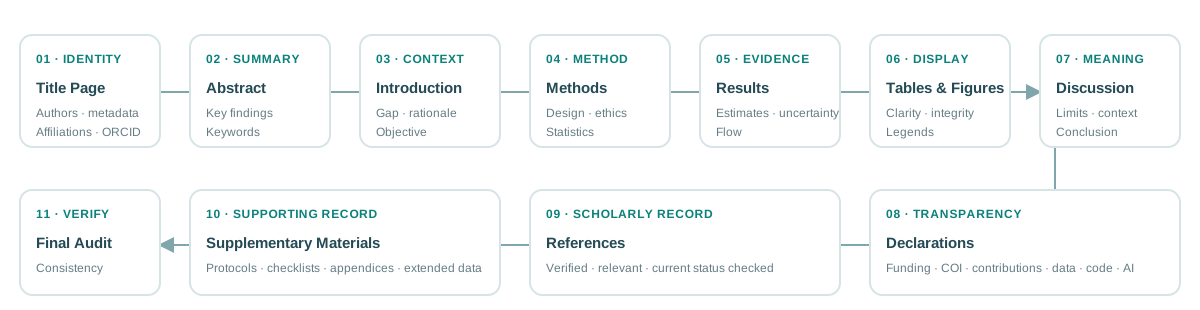
Treata’s Manuscript Preparation Manual establishes a rigorous publisher-level approach to preparing scholarly articles. It does not replace the target journal’s article-type instructions. Journal-specific requirements may define word limits, abstract format, reference style, figure specifications, mandatory files, reporting checklists, data settings, or declarations.
Begin with the scientific record and then apply the journal’s presentation rules. Formatting should never be used to hide methodological limitations, alter the meaning of results, or avoid an applicable reporting requirement.
Where a journal-specific instruction appears inconsistent with a canonical Treata Master Publishing Policy, authors should seek clarification before submission.
2. Build a Controlled Manuscript File
Maintain one authoritative working manuscript during final preparation. Use version control appropriate to the project and avoid parallel copies whose changes cannot be reconciled reliably.
Before submission, remove editing debris such as unresolved comments, accidental tracked changes, hidden text, obsolete tables, duplicate references, and internal notes. Preserve research records separately; cleaning the submission file should not destroy provenance.
Use stable styles for headings, captions, tables, equations, and references so that the document can be converted reliably during production.
3. Follow a Logical Article Architecture
Most empirical research articles contain a title, abstract, keywords, introduction, methods, results, discussion, declarations, references, tables, figures, and supplementary material where needed. Other article types can require different structures.
Structure should help readers distinguish what was planned, what was done, what was observed, and how the findings are interpreted. Avoid mixing results into Methods or presenting new unreported analyses for the first time in the Discussion.
Use informative headings and subheadings when the journal permits them. Long uninterrupted blocks of text make methodological assessment harder.
4. Prepare the Title Page as a Metadata Source
The title page should be treated as the authoritative source for core submission metadata. Include the exact manuscript title, author names in the required form, affiliations, corresponding-author details, and other items required by the journal.
Depending on journal configuration, the title page may also include ORCID identifiers, author contributions, funding, competing interests, acknowledgements, word counts, number of tables and figures, data statement, registration information, or a running title.
Ensure spelling and ordering match the submission system. Production errors often originate in inconsistent author names or affiliations across files.
5. Write an Accurate Manuscript Title
The title should identify the subject and, where useful or required, the study design, population, setting, or central relationship. It should be searchable without becoming an abstract.
Avoid unsupported claims of causality, priority, universality, or importance. Words such as 'first', 'definitive', 'breakthrough', or 'proven' require exceptional justification.
Do not use a title that implies a randomized trial, systematic review, diagnostic-accuracy study, prediction model, or other design unless the manuscript actually meets that design.
6. Standardize Author Names and Affiliations
Use each author’s preferred scholarly name consistently and provide institutional affiliations that reflect where the work was performed or the journal’s specified convention.
Do not manipulate affiliations to imply endorsement by an institution that did not support or host the work. Current addresses can be listed separately when allowed.
Check diacritics, compound surnames, transliteration, initials, institutional hierarchy, city, and country carefully because these fields feed indexing and metadata systems.
7. Identify the Corresponding Author Clearly
The corresponding author coordinates communication with the journal and author group. Provide an email address that will remain monitored during review and after publication.
The corresponding-author role does not confer ownership of the work or sole authority to change authorship, data, interpretation, or disclosures.
If more than one corresponding author is permitted, follow the journal’s metadata rules so the designation is represented consistently.
8. Use ORCID and Other Identifiers Accurately
Where ORCID is requested or supported, each identifier should belong to the named author. Authors should authenticate their own identifiers when the submission system permits.
Do not create, guess, or copy an ORCID for another person. An identifier is useful only when it resolves to the correct researcher.
Persistent identifiers support disambiguation and metadata quality but do not replace accurate names, affiliations, or contribution statements.
9. Prepare a Structured or Unstructured Abstract Correctly
Follow the article type’s required abstract format. For empirical health research, structured headings may include objectives, methods, results, and conclusions, but the exact headings vary by journal and study design.
The abstract must stand on its own and remain consistent with the main text. Include essential design, setting or participants where relevant, principal methods, major quantitative findings, uncertainty measures where appropriate, and a proportionate conclusion.
Do not introduce outcomes, sample sizes, analyses, or claims that are absent from the main article.
10. Report Numbers Carefully in the Abstract
Verify every number against the final results. Sample sizes, event counts, effect estimates, confidence intervals, p-values, dates, and percentages are common sources of inconsistency.
Whenever possible, emphasize effect size and uncertainty rather than reducing interpretation to statistical significance alone.
If the study has prespecified primary outcomes, the abstract should not selectively foreground a more favorable secondary or exploratory result without appropriate context.
11. Select Useful Keywords
Choose keywords that improve discovery and accurately represent the article. Where the journal requires a controlled vocabulary such as MeSH, use valid terms and follow its instructions.
Do not repeat only words already present in the title when additional terms can improve retrieval. Include important concepts, population, condition, intervention, method, or setting as appropriate.
Keywords are metadata, not promotional tags. Avoid irrelevant high-traffic terms.
12. Write the Introduction Around the Research Need
The Introduction should establish what is known, what remains uncertain, why the question matters, and what the study set out to determine.
Use a focused literature context rather than an exhaustive review. Cite primary and high-quality synthesis evidence where appropriate and avoid selective citation that makes the knowledge gap appear larger than it is.
End with a clear objective, research question, or hypothesis that aligns with the Methods and reported outcomes.
13. Avoid Overclaiming Novelty
Claims that no previous study exists are difficult to establish. Use precise language such as 'we identified limited evidence' when that is what the literature search supports.
Novelty can arise from population, method, data, theory, implementation, validation, or synthesis; it need not mean that no related work has ever been published.
Do not disparage prior research merely to strengthen the manuscript’s perceived importance.
14. Make the Methods Reproducible
The Methods should allow a knowledgeable reader to understand how the research was designed, conducted, measured, and analyzed. Report enough detail to assess bias, reproducibility, and applicability.
Typical elements include design, setting, dates, participants or materials, eligibility, recruitment or sampling, interventions or exposures, outcomes, measurements, equipment, procedures, quality control, ethics, and analysis.
Use supplementary material, protocols, repositories, or prior methodological papers for extensive detail when appropriate, but do not omit information essential to interpreting the present study.
15. State Study Design Precisely
Use recognized design terminology accurately. Cohort, case-control, cross-sectional, randomized trial, diagnostic-accuracy study, prediction-model study, qualitative study, systematic review, and other designs have distinct implications.
Describe prospective or retrospective features carefully. A study is not necessarily prospective merely because a protocol was written before analysis.
If the project combines designs, explain the components rather than forcing it into one inaccurate label.
16. Describe Setting and Study Dates
Report where and when the study occurred to the degree needed for interpretation. Clinical practice, diagnostic technology, public-health conditions, policies, and standards of care can change over time.
Distinguish recruitment dates, data-collection dates, follow-up period, database coverage, and analysis dates when those differences matter.
Protect participant privacy when precise locations or dates could enable identification.
17. Define Participants, Samples or Materials
State inclusion and exclusion criteria and how eligible units were identified. Explain sampling or recruitment and whether participants were consecutive, random, convenience-based, population-based, or selected by another method.
Report the source population or sampling frame when relevant. Readers should be able to understand who could enter the study and why some units did not.
For laboratory, computational, environmental, or other non-human studies, provide equivalent provenance and selection information for specimens, datasets, models, or materials.
18. Describe Interventions and Exposures
Provide enough detail about interventions, comparators, exposures, devices, procedures, doses, timing, duration, adherence, and co-interventions to permit scientific evaluation.
Use recognized intervention-reporting extensions when applicable. If a proprietary product is central to reproducibility, provide manufacturer and model information as appropriate without turning the Methods into advertising.
Distinguish planned intervention components from deviations that occurred during the study.
19. Define Outcomes and Variables
Define primary and secondary outcomes, predictors, exposures, confounders, effect modifiers, diagnostic thresholds, and derived variables clearly.
State how and when outcomes were measured, by whom or by what instrument, and whether assessors were blinded where relevant.
Do not redefine an outcome after analysis without disclosing the change and its timing.
20. Report Measurement Quality
Describe measurement instruments, laboratory assays, imaging methods, questionnaires, scales, calibration, inter-rater procedures, validation, and quality-control processes as relevant.
If a translated or adapted instrument was used, describe the version and any validation or permission requirements.
Report limits of detection, measurement error, reliability, or other performance characteristics when they materially affect interpretation.
21. Report Sample-Size Planning
Explain how the sample size was determined when formal planning was applicable. Identify the primary parameter or outcome, assumptions, expected effect, variability or event rate, alpha, power, allocation, attrition allowance, and software where relevant.
A post hoc power calculation does not repair an underpowered study and should not be presented as if it were prospective planning.
For exploratory, qualitative, rare-disease, registry, or fixed-dataset research, explain the rationale or constraints appropriate to the design rather than fabricating a conventional power calculation.
22. Write the Statistical Analysis Section for Reproducibility
Describe the analysis sufficiently for a qualified reader to understand what was done and why. Name statistical models and major tests, define analysis populations, and state how assumptions were assessed where relevant.
Report handling of continuous and categorical variables, transformations, clustering, repeated measures, matching, weighting, confounding, interactions, multiple comparisons, missing data, and sensitivity analyses as applicable.
Identify software and version when required or useful for reproducibility. Custom code can be cited or shared according to the data and code policy.
23. Distinguish Prespecified and Exploratory Analyses
Readers should be able to distinguish analyses planned before examining the relevant results from analyses generated during exploration.
Exploratory analyses can be scientifically valuable, but labeling them accurately affects interpretation and replication.
For registered or protocol-driven studies, explain material deviations from the prespecified analysis rather than rewriting the history of the study.
24. Handle Missing Data Transparently
Report the extent and pattern of missing data where relevant, the assumptions made, and the methods used to address missingness.
Complete-case analysis, single imputation, multiple imputation, inverse-probability methods, model-based approaches, or other techniques have different assumptions. Name the method rather than saying only that missing data were 'handled'.
Consider sensitivity analyses when conclusions depend strongly on unverifiable assumptions about missingness.
25. Report Statistical Uncertainty
Provide effect estimates with appropriate measures of uncertainty such as confidence or credible intervals when suitable for the design.
Do not interpret a p-value as the probability that a hypothesis is true or that a result occurred by chance. Avoid equating statistical significance with clinical, scientific, or practical importance.
Report exact p-values when journal style and statistical practice permit, except where very small values are appropriately expressed as thresholds.
26. Address Multiplicity and Subgroups
When many outcomes, time points, models, comparisons, or subgroup analyses are evaluated, explain the strategy for multiplicity or the exploratory nature of the work.
Subgroup analyses should identify the subgroup definition, rationale, prespecification status, interaction assessment where relevant, and limitations.
Do not claim that a treatment works in one subgroup and not another merely because one within-group p-value is significant and the other is not.
27. Report Model Development and Validation Transparently
For prediction, prognostic, diagnostic, machine-learning, or other modeling studies, describe candidate predictors, preprocessing, feature selection, tuning, internal validation, external validation, performance measures, calibration, discrimination, and overfitting controls as applicable.
Separate development and evaluation data clearly. Data leakage can produce misleading performance even when code runs correctly.
Use applicable reporting frameworks and provide enough information for independent assessment or implementation.
28. Describe Qualitative Methods Completely
Qualitative manuscripts should identify the methodological orientation, researcher roles or reflexivity where relevant, sampling, recruitment, setting, data collection, recording, transcription, coding, analysis, saturation or information-power rationale where used, and methods supporting credibility.
Participant quotations should be presented with privacy safeguards and sufficient context. Translation processes should be described when quotations were translated.
Use an appropriate reporting guideline such as COREQ or SRQR when required or suitable.
29. Describe Systematic Review Methods Prospectively
For systematic reviews and meta-analyses, report eligibility criteria, information sources, full search strategy, selection process, data collection, risk-of-bias assessment, effect measures, synthesis methods, heterogeneity, reporting-bias assessment, certainty assessment where applicable, and registration or protocol information.
Search methods should be reproducible. Report the date each source was last searched and provide complete strategies for at least the databases required by the reporting standard or journal.
Do not call a review 'systematic' merely because several databases were searched.
30. Report Laboratory and Experimental Methods with Provenance
Identify materials, reagents, cell lines, organisms, antibodies, instruments, software, and experimental conditions at the level needed to assess and reproduce the work.
Report authentication, contamination testing, biological and technical replicates, randomization, blinding, exclusions, and quality controls where relevant.
Distinguish independent experimental units from repeated measurements to avoid pseudoreplication.
31. Integrate Ethics Information into Methods
State the responsible ethics body, approval or determination, reference number where applicable, and relevant consent information according to journal policy.
For exempt or waived research, describe the determination accurately rather than implying that no ethics consideration was necessary.
Clinical trial registration, animal approvals, permits, or other oversight information should appear in the location required by the journal and remain consistent across the manuscript and submission metadata.
32. Present Results Without Interpretation Drift
The Results should report what the study found. Organize them around the objectives and prespecified outcomes rather than around which findings appear most exciting.
Start with participant, sample, or dataset flow and descriptive characteristics where relevant, then report primary and secondary analyses in a logical sequence.
Reserve broad interpretation, mechanisms, comparison with literature, and recommendations primarily for the Discussion.
33. Report Participant or Sample Flow
State how many units were assessed, included, excluded, allocated, followed, analyzed, or otherwise moved through the study when applicable.
Give reasons for important exclusions and losses. Denominators should be clear for percentages and analyses.
Use a flow diagram when required by the relevant reporting guideline or when it materially improves understanding.
34. Keep Numbers Consistent Across the Article
Perform a numerical audit across abstract, Methods, Results, tables, figures, supplements, and data outputs.
Common discrepancies include sample size, percentages that use different denominators, confidence intervals that do not match estimates, inconsistent decimal precision, and values copied from earlier analyses.
Automated tables or reproducible reporting pipelines can reduce transcription errors, but authors must still verify the final rendered manuscript.
35. Write Tables as Independent Evidence Displays
A table should communicate information efficiently without requiring readers to reconstruct its meaning from the main text. Use a concise title and define abbreviations, units, statistical measures, groups, and relevant denominators in headings or footnotes.
Do not duplicate the same complete dataset in text, table, and figure. The text should highlight the most important patterns rather than recite every cell.
Indicate missing values, reference categories, adjusted models, statistical tests, and multiple-comparison conventions when needed.
36. Design Figures for Scientific Clarity
Figures should reveal data or concepts rather than decorate the manuscript. Choose a graph type appropriate to the data and avoid visual encodings that exaggerate differences.
Label axes, units, groups, panels, legends, scale bars, uncertainty displays, and statistical annotations clearly. Avoid unnecessary three-dimensional effects and misleading truncated axes.
Consider accessibility, including legible text, sufficient contrast, and not relying on color alone to convey essential distinctions.
37. Preserve Image Integrity
Scientific images must remain faithful to the underlying data. Global adjustments to brightness, contrast, or color may be acceptable when applied consistently and when they do not obscure or create information, subject to discipline and journal rules.
Do not selectively enhance, erase, move, duplicate, or splice features in a misleading way. Disclose legitimate assembly of images from different fields, exposures, time points, or experiments as appropriate.
Retain original, unprocessed source files. Editors may request them for verification.
38. Prepare Figure Legends as Part of the Record
Legends should allow readers to understand the figure without guessing. Explain panels, symbols, abbreviations, error bars, scale bars, sample sizes, statistical tests, and relevant experimental conditions.
State whether displayed values are mean, median, model estimate, individual observations, or another quantity, and define uncertainty displays.
Do not hide essential methodological information solely in a legend when it belongs in Methods as well.
39. Prepare Publication-Quality Figure Files
Follow the target journal’s current requirements for file type, resolution, dimensions, fonts, line weight, color mode, and separate uploads.
Export from the original application when possible rather than using screenshots. Verify that conversion has not changed symbols, transparency, labels, or image quality.
Keep editable source files even when the journal requests flattened publication formats.
40. Report Results in Text Selectively
Use prose to guide the reader through the central findings and their sequence. Report key estimates and uncertainty, but avoid repeating every number already visible in a table.
Do not describe non-significant findings as 'trends' merely because they point in a preferred direction. Likewise, do not dismiss a scientifically important estimate solely because a threshold was not crossed.
Separate planned primary findings from exploratory observations.
41. Structure the Discussion Around Interpretation
A useful Discussion commonly begins with the principal findings, places them in context, explores plausible explanations, considers strengths and limitations, discusses implications, and ends with a proportionate conclusion.
Do not repeat the Introduction or Results at length. The Discussion should add interpretation while remaining anchored to the evidence.
Address credible alternative explanations rather than constructing a narrative in which all findings confirm the authors’ preferred hypothesis.
42. Compare with Previous Evidence Fairly
Explain agreements and differences with relevant prior work, considering differences in design, population, measurement, setting, analysis, and bias.
Do not cite only studies that support the manuscript’s conclusion. Where credible evidence conflicts, represent it fairly.
Systematic reviews and high-quality primary studies can help contextualize findings, but citation choice should be driven by relevance rather than prestige.
43. Report Limitations Specifically
Limitations should explain how particular features could affect validity, precision, interpretation, or generalizability. Generic statements such as 'more research is needed' are not enough.
Consider selection bias, measurement error, confounding, missing data, sample size, multiplicity, model assumptions, external validity, protocol deviations, and unmeasured factors as relevant.
Do not use the limitations section to dismiss every concern automatically. Explain direction and likely importance where possible.
44. Discuss Generalizability and Applicability
State to which populations, settings, technologies, periods, or circumstances the findings may reasonably apply.
External validity depends on more than sample size. Eligibility, recruitment, geography, health system, prevalence, implementation conditions, and study procedures can matter.
A single-center or regional study can be valuable without pretending to represent every setting.
45. Write a Proportionate Conclusion
The conclusion should answer the research question at the level supported by the design and results. Avoid causal claims from designs that cannot support them without strong assumptions.
Do not introduce new results or recommendations in the conclusion.
Where uncertainty is substantial, state it. A careful conclusion strengthens rather than weakens a manuscript.
46. Prepare Acknowledgements Transparently
Acknowledge people or organizations that contributed materially but do not qualify for authorship, subject to consent and journal requirements.
Describe medical writing, language editing, technical support, statistical assistance, or other relevant support when required.
Do not use acknowledgements to conceal contributors who actually meet authorship criteria.
47. Write the Funding Statement
Identify financial and material support accurately, including grant numbers where applicable. Use standardized funder names when the submission system or journal supports them.
State the sponsor’s role in design, conduct, analysis, interpretation, writing, and publication decisions when required.
Funding statements should agree with submission metadata and acknowledgements.
48. Write the Competing-Interest Statement
Provide the disclosures required by the journal and applicable Treata policy. Each author should supply their own relevant information when individual disclosure is required.
Do not assume that disclosure means misconduct or disqualification. Transparency allows editors and readers to assess relationships appropriately.
If there are no relevant competing interests, use the journal’s required no-conflict wording rather than leaving the section blank.
49. Write the Author-Contribution Statement
Describe who did what using the journal’s required format, including CRediT roles where applicable.
Contribution statements should be consistent with the author list and should not be used to justify honorary authorship.
All authors remain accountable under the applicable authorship policy even when roles are differentiated.
50. Write the Data Availability Statement
State where the data supporting the findings can be found and under what conditions they can be accessed. Include repository names, persistent identifiers, accession numbers, or controlled-access procedures where available.
If data cannot be shared openly, give the legitimate reason and describe feasible access conditions without promising access that the authors lack authority to grant.
Avoid vague statements such as 'data available on request' when the journal requires a more specific explanation or when legal or ethical restrictions make such access unrealistic.
51. Write the Code Availability Statement
Identify code necessary to reproduce or implement the analysis and state where it is available, including repository and persistent identifier where appropriate.
Document software versions, dependencies, configuration, and execution instructions sufficiently for the intended level of reproducibility.
If code is proprietary, security-sensitive, or otherwise restricted, state the limitation accurately and provide any permissible alternative.
52. Report AI Use Appropriately
Follow the journal’s current AI disclosure requirements. AI-assisted technologies cannot be authors, and human authors remain responsible for all submitted content.
If AI was used as part of the research method, describe the tool or model, relevant version or access information, purpose, inputs, validation, human oversight, and limitations at the level needed for scientific evaluation.
For writing or language assistance, disclose use when required and verify all generated text, references, calculations, and claims independently.
53. Include Registration and Protocol Information
Provide registry name and identifier for clinical trials and other registered studies where required. Ensure identifiers are exact and consistent across abstract, Methods, title page, and metadata.
State protocol availability and provide a persistent link or citation when applicable.
Disclose material differences between registration, protocol, statistical analysis plan, and final report rather than silently updating the narrative.
54. Address Preprints and Prior Dissemination
Disclose relevant preprints, conference abstracts, protocols, theses, reports, or related publications according to journal policy.
Explain overlap when the same dataset has supported other manuscripts. Readers and editors should be able to understand what is distinct in the present article.
Do not copy text from prior publications without appropriate quotation, citation, permission where required, and consideration of text-recycling policy.
55. Manage Copyright and Permissions
Confirm that the authors have rights to submit all manuscript content. Obtain permission for third-party figures, tables, questionnaires, maps, images, or substantial excerpts when the intended reuse is not already authorized by license or law.
Record required credit lines and license terms. Citation alone does not grant reuse rights.
Ensure that permissions are compatible with the license under which the final article will be published.
56. Prepare Supplementary Materials Deliberately
Supplementary files should contain material that genuinely supports transparency or interpretation but cannot be accommodated appropriately in the main article.
Examples can include extended methods, additional analyses, checklists, protocols, code documentation, appendices, multimedia, or large tables, subject to journal rules.
Supplementary material is part of the scholarly record. Apply the same standards of accuracy, privacy, permissions, and integrity.
57. Name and Cite Supplementary Files Consistently
Use stable labels such as Supplementary Table, Figure, Appendix, Dataset, or File according to journal style and cite every intended supplement from the manuscript.
Check that numbering, filenames, titles, and citations match after final revisions.
Do not refer to a supplement that is missing from the submission package.
58. Prepare References from the Source, Not Memory
Every reference should correspond to a real source that the authors have checked sufficiently to support the cited statement.
Verify author names, title, source, year, volume, issue where required, pages or article number, DOI, and other identifiers. Reference-manager metadata can contain errors.
Do not rely on AI-generated citations without verification against the original source.
59. Prefer Appropriate Primary and Synthesis Evidence
Cite primary evidence when discussing specific findings and high-quality systematic or authoritative synthesis when describing an evidence base.
Avoid citing a secondary source as if it directly performed the original experiment or study.
Reference selection should represent the relevant literature fairly, including important evidence that does not support the manuscript’s preferred interpretation.
60. Check Retractions, Corrections and Updates
Before submission, verify important references for retractions, major corrections, expressions of concern, or replacement by materially updated guidance.
A retracted article may occasionally be cited for historical or methodological discussion, but its status and reason for citation should be clear.
Do not continue to rely on invalidated evidence merely because it already appears in the reference manager.
61. Avoid Citation Manipulation
Do not add irrelevant citations to inflate author, journal, reviewer, editor, institution, or network metrics.
Legitimate self-citation is appropriate when prior work is directly relevant. Excessive or strategically irrelevant self-citation is not.
If a reviewer or editor requests irrelevant citations, authors can explain why they are unnecessary.
62. Use Reporting Guidelines as Writing Tools
Apply the reporting guideline during manuscript preparation, not only at the upload stage. Each checklist item can reveal missing information in Methods, Results, figures, or declarations.
Use the guideline and extension that best match the study design. EQUATOR provides a searchable resource for health-research reporting guidelines.
Reporting compliance improves transparency but does not guarantee methodological quality; both must be assessed.
63. Maintain Consistent Terminology
Use consistent names for groups, outcomes, variables, interventions, datasets, time points, and models throughout the manuscript.
Define abbreviations once and avoid multiple abbreviations for the same concept. Excessive abbreviation makes interdisciplinary reading difficult.
Use recognized scientific nomenclature and current respectful terminology for people and populations.
64. Use Units and Numerical Precision Consistently
Use SI units or discipline-specific standards according to journal instructions. Define non-standard units and ensure conversions are correct.
Choose decimal precision that reflects measurement and analytical precision rather than displaying meaningless digits.
Use the same units for a variable across text, tables, and figures unless a clearly labeled conversion serves a scientific purpose.
65. Prepare Equations and Symbols Reliably
Use editable equation formats where the journal supports them and define all non-standard symbols.
Check subscripts, superscripts, Greek letters, minus signs, multiplication symbols, and special characters after file conversion.
Number equations only when they need to be cited or when journal style requires it.
66. Write for Accessibility and International Readership
Use direct scientific language, informative headings, and clear sentence structure. Avoid unnecessary idioms and culturally specific shorthand.
Figures should not rely solely on color to distinguish essential information, and text should remain legible at publication size.
Define specialist terms when the intended readership crosses disciplines.
67. Use Language Editing Responsibly
Professional editing, translation, or AI-assisted language support may improve clarity, but authors remain responsible for meaning, accuracy, originality, and disclosure requirements.
Do not allow editing to strengthen causal claims, remove uncertainty, alter statistical interpretation, or change technical terminology incorrectly.
Where substantial writing assistance requires acknowledgement or disclosure under journal policy, provide it.
68. Prepare the Manuscript for Blinded Review
When the journal uses blinded review, follow its anonymization instructions exactly. Remove author names and affiliations from the blinded file and inspect acknowledgements, contributions, ethics wording, self-references, repository links, filenames, document properties, and supplements.
Do not rewrite references unnaturally merely to hide identity unless the journal specifically requires a particular approach.
Maintain a complete unblinded version separately for editorial and production use.
69. Audit File Metadata
Inspect document properties, PDF metadata, comments, tracked changes, hidden fields, image metadata, spreadsheet tabs, and filenames for unintended author identity or confidential information.
Metadata cleaning should target submission privacy, not destroy research provenance or source records.
Open the final exported files after cleaning to ensure content was not damaged.
70. Prepare a Journal-Ready File Package
Follow the target journal’s requirements for manuscript file type, separate title page, figures, tables, supplements, checklists, graphical abstracts, highlights, permissions, or other components.
Use clear filenames and include only final intended files. Obsolete drafts in an upload folder are a common source of submission errors.
Where a journal requests source files, ensure they contain the same scientific content as the review version.
71. Perform a Cross-Document Consistency Check
Compare title page, abstract, manuscript, tables, figures, supplements, reporting checklist, registry, protocol, data statement, code statement, funding, conflicts, and submission metadata.
Check author names, sample sizes, dates, outcomes, ethics number, registration identifier, numerical results, repository links, and declarations.
Resolve discrepancies before submission rather than expecting editors to infer which version is correct.
72. Perform the Final Scientific Read
Read the manuscript once as a skeptical expert rather than as its author. Ask whether the question is clear, methods support the claims, results are complete, figures are honest, uncertainty is visible, and conclusions follow from the evidence.
Look specifically for statements that are stronger than the data, unexplained exclusions, post hoc analyses presented as planned, missing denominators, and references that do not support the claim.
A technically formatted manuscript is not ready if its scientific narrative is misleading.
73. Perform the Final Editorial Read
Read again for organization, repetition, undefined terms, inconsistent headings, grammar, formatting, broken cross-references, table and figure citations, supplementary citations, and reference numbering.
Confirm that all abbreviations, units, symbols, and acronyms are defined and used consistently.
Check that the title and abstract still match the final manuscript after late-stage revisions.
74. Preserve the Submission-Ready Version
Save the exact approved manuscript and associated files before uploading. Preserve a read-only or otherwise controlled copy as the author group’s record.
Record the version date and, for complex projects, a version identifier or repository commit.
This makes later revisions, integrity inquiries, and production comparisons much easier.
75. Treata Manuscript Preparation Rule
Treata separates universal publishing standards from journal configuration. This manual describes publisher-level preparation expectations; each journal defines its operational article types, formatting, file requirements, review configuration, license, fees, and other settings.
Authors should prepare the manuscript to satisfy both the applicable Master Publishing Policies and the target journal’s current Instructions for Authors.
Where a journal permits flexibility, scientific transparency and integrity take priority over cosmetic uniformity.
Related author guidance
Continue preparing the article
Canonical standards