1. The Reviewer’s Role in Editorial Decision-Making
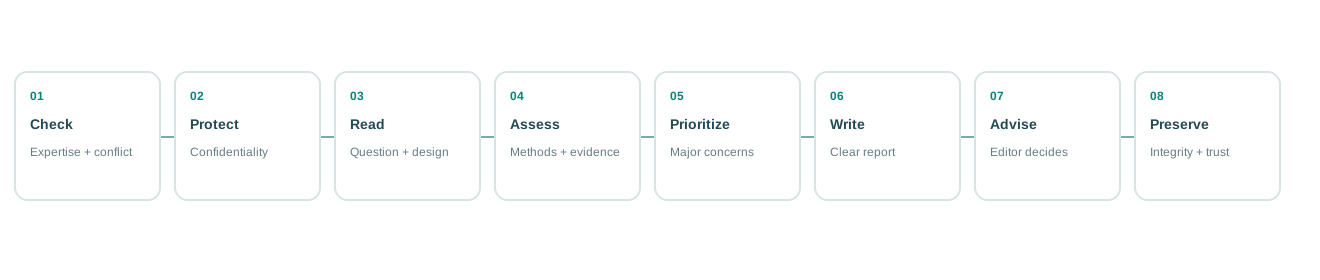
Peer reviewers provide expert advice to editors; they do not make the editorial decision. A useful review evaluates whether the manuscript’s question, methods, analysis, reporting and interpretation are sufficiently reliable and clear for the editor to reach an informed judgment.
Reviewers should distinguish major scientific concerns from correctable reporting problems and from personal preferences. The aim is not to rewrite a manuscript into the reviewer’s preferred style, but to identify issues that materially affect validity, transparency, interpretation, reproducibility or usefulness.
Treata expects reviews to be evidence-based, proportionate and respectful. Strong criticism can be appropriate when the science warrants it, but criticism should address the work rather than the authors.
2. Accept a Review Only When You Can Do It Properly
Before accepting an invitation, assess whether the manuscript is sufficiently close to your expertise, whether you can meet the deadline, and whether any competing interest could impair—or reasonably appear to impair—your objectivity.
A reviewer does not need to be an expert in every aspect of a multidisciplinary paper. However, limitations in expertise should be disclosed to the editor when they affect the scope of the review. Do not accept simply to gain access to an unpublished manuscript.
If the deadline is unrealistic, decline or request an extension promptly. A fast superficial review is less useful than a timely, well-scoped decision about whether you can contribute.
3. Confidentiality Begins With the Invitation
The manuscript, invitation, reviewer report and editorial correspondence are confidential unless the journal explicitly operates a model that provides otherwise. Do not share the manuscript, use its unpublished ideas for personal advantage, or discuss its contents with unauthorized colleagues.
If specialist input from another person would materially improve the review, obtain the editor’s permission before sharing the manuscript and ensure the contributor is appropriately recognized under journal policy.
Confidentiality also applies after the review is submitted. Publication of the paper does not automatically authorize disclosure of confidential editorial communications or the identity of participants in a confidential review process.
4. Competing Interests and Recusal
Potential conflicts can be financial, professional, academic, institutional or personal. Recent collaboration, direct competition, supervisory relationships, disputes, commercial interests or close personal relationships may affect—or appear to affect—independent assessment.
Disclose the relevant relationship to the editor rather than deciding privately that it does not matter. The editor determines whether the conflict requires recusal or can be managed.
A reviewer who recognizes an author despite blinded review should consider whether that knowledge creates a conflict and should follow the journal’s instructions rather than attempting to investigate author identity further.
5. Read for the Research Question Before Reading for Faults
Begin by identifying what the study asks, why the question matters, what design was used and what evidence the authors claim answers it. This creates a framework for evaluating the manuscript as a whole.
Then examine whether the design can answer the stated question, whether outcomes and analyses correspond to the methods, and whether conclusions remain within the limits of the evidence.
A review that starts only by collecting isolated errors can miss the central scientific issue. Conversely, a promising question should not distract from serious methodological or ethical problems.
6. Evaluate Methods for Validity and Reproducibility
Assess whether the population, setting, design, interventions or exposures, outcomes, measurements and analytical methods are described sufficiently to understand what was done. Consider bias, confounding, missing data, sample-size reasoning and whether key methodological decisions appear prespecified or exploratory.
Use the appropriate reporting guideline as an aid when relevant. Reporting checklists help identify missing information, but a completed checklist is not proof that the study design is sound.
Do not demand methods that are fashionable but unnecessary. Requests should be tied to the research question, design and credible threats to validity.
7. Evaluate Statistics Without Turning Review Into Methodological Theatre
Focus on whether the statistical approach is appropriate for the design and data, whether assumptions and uncertainty are addressed, and whether reported numbers are internally consistent. Pay attention to denominators, missing data, multiplicity, subgroup analyses and selective emphasis on P values.
If a specialized statistical issue is outside your expertise, tell the editor rather than presenting uncertain criticism as definitive. Recommend statistical review when it is genuinely needed.
Do not request additional analyses merely because they are possible. New analyses should have a clear scientific purpose and should not encourage data dredging or retrospective rewriting of the study plan.
8. Read Results Against Methods, Tables and Figures
The Results should correspond to the analyses described in Methods, and the abstract, text, tables, figures and supplements should tell the same numerical story. Look for unexplained changes in denominators, inconsistent event counts, implausible precision or conclusions not supported by the displayed results.
Tables and figures should add clarity rather than duplicate large amounts of text. Image-based evidence should be examined for presentation problems or potential integrity concerns without assuming misconduct from visual irregularity alone.
When you identify an inconsistency, describe exactly where it occurs and why it matters. Specific observations are more actionable than broad statements that the results are “unclear.”
9. Judge Interpretation in Proportion to the Evidence
Assess whether the Discussion acknowledges important limitations, places findings in appropriate context and distinguishes association from causation where relevant. Conclusions should not extend beyond the population, design or uncertainty supported by the study.
Novelty should not be treated as a substitute for reliability. Replication, negative results and confirmatory work can be valuable when the question and methods are sound.
Equally, do not require authors to cite or endorse the reviewer’s preferred interpretation when multiple reasonable interpretations exist. Explain the evidentiary basis for any requested change.
10. Ethics, Consent and Participant Protection
Reviewers should check whether human or animal research includes appropriate ethics information and whether the reported conduct raises credible concerns. This includes consent, privacy, vulnerable populations, trial registration and animal welfare where relevant.
A reviewer should not attempt to conduct an institutional investigation. If documentation appears missing, contradictory or implausible, flag the concern confidentially to the editor with the specific evidence that triggered it.
Do not request identifying participant information simply to satisfy curiosity. Verification should be proportionate and routed through the editor.
11. Research Data, Code and Reproducibility
Assess whether the Data Availability Statement is consistent with the study and whether access restrictions are explained. For computationally intensive work, consider whether code, model details, software versions or other materials are needed to evaluate reproducibility.
Do not demand public release of data when privacy, consent, legal or contractual constraints make unrestricted sharing inappropriate. Controlled access can be a legitimate solution.
If you use data or code supplied confidentially for review, treat those materials under the same confidentiality obligations as the manuscript.
12. Reporting Guidelines as Review Tools
CONSORT, STROBE, PRISMA, STARD, TRIPOD, CARE, COREQ, ARRIVE and other reporting guidelines can help reviewers identify information necessary to assess a study. Use the guideline that matches the design and relevant extension.
The purpose is completeness and transparency, not mechanical scoring. A manuscript can report a flawed study completely, and a well-designed study can be difficult to evaluate because reporting is incomplete.
When requesting reporting improvements, identify the missing information and its relevance rather than simply telling authors to “follow CONSORT” or another guideline without explanation.
13. Writing Major and Minor Comments
Major comments should identify issues that materially affect validity, interpretation, ethics, reproducibility or the editor’s decision. Minor comments should address correctable clarity, reporting or presentation issues that do not determine the central scientific assessment.
Prioritize. A report containing dozens of equally weighted comments can hide the few issues that actually matter.
Whenever possible, connect each major concern to a concrete manuscript location and explain what information, clarification or analysis would resolve the concern.
14. Recommendations to the Editor
If the journal asks for a recommendation category, base it on the manuscript’s scientific and reporting status under that journal’s criteria. The confidential recommendation and the comments to authors should not contradict one another without explanation.
Avoid using recommendation categories as a substitute for reasoning. Editors need to understand which concerns are potentially correctable and which undermine the work more fundamentally.
Do not tell authors directly that a paper “must be accepted” or “will be rejected.” The editorial decision belongs to the editor.
15. Respectful and Inclusive Reviewer Language
Write as though the review may become part of a durable scholarly record. Critique claims, methods and reporting—not presumed intelligence, motives, language background, nationality, institution or career stage.
Avoid sarcasm, humiliation and dismissive language. If English or presentation problems impede scientific evaluation, identify the affected passages or recommend language editing without making assumptions about the authors.
Respect does not require weakening a serious criticism. Precision and professionalism usually make strong criticism more persuasive.
16. Citation Requests and Reviewer Self-Interest
Recommend citations when they are genuinely relevant to understanding the work. Do not pressure authors to cite your publications, the journal, your collaborators or a preferred school of thought merely to increase citation counts.
A reviewer may identify important missing literature, but should explain its relevance rather than provide a long compulsory citation list.
Editors may treat coercive or excessive citation requests as reviewer misconduct. Treata expects citation suggestions to serve the manuscript, not the reviewer.
17. Suspected Plagiarism, Fabrication or Manipulation
If you encounter suspicious textual overlap, impossible data patterns, image irregularities, implausible results or signs of peer-review manipulation, document the specific concern and alert the editor confidentially.
Do not accuse authors publicly or conduct intrusive investigations outside the journal process. Similarity can have legitimate explanations, and apparent anomalies require assessment before conclusions are drawn.
Preserve confidentiality while the editor determines whether further checks, institutional involvement or other integrity procedures are appropriate.
18. AI Use in Peer Review
Peer-review materials are confidential. Reviewers should not upload an unpublished manuscript, figures, data or editorial correspondence to an external generative-AI service unless the journal explicitly permits the use and the confidentiality, data-use and security conditions are acceptable.
AI may produce plausible but incorrect critiques, citations or methodological claims. Any permitted AI assistance therefore requires independent human verification, and the reviewer remains responsible for the submitted report.
AI should not replace the reviewer’s expert judgment. Where journal policy requires disclosure of AI assistance, reviewers should disclose it accurately.
19. Co-Reviewing and Reviewer Development
Co-review can be valuable for training and multidisciplinary expertise when it is authorized by the journal. The invited reviewer should not secretly delegate the review to a trainee or colleague.
Seek editor permission, protect confidentiality and identify contributors according to journal policy. The invited reviewer should supervise the process and take responsibility for the final report.
Good reviewer development teaches reasoning, evidence assessment, ethical responsibility and constructive communication—not merely how to produce a long list of criticisms.
20. Revised Manuscripts and Second-Round Review
When reviewing a revision, read the editor’s decision, prior comments, author response and revised manuscript together. Check whether the authors addressed the scientific concern rather than merely changing wording.
Do not introduce an entirely new set of optional demands simply because another round is available. New major issues may legitimately emerge, especially if revisions create them, but review should converge when prior concerns have been adequately resolved.
If authors disagree with a recommendation, assess the reasoning fairly. A justified disagreement is not noncompliance.
21. Reviewer Timeliness and Communication
Accept only deadlines you can reasonably meet. If circumstances change, notify the editorial office early rather than allowing the review to become indefinitely overdue.
If a critical question arises during review—such as a serious conflict, a confidentiality issue or uncertainty about scope—contact the editor rather than contacting the authors directly.
Timeliness matters because delayed review affects authors, editors and the research record, but speed should not come at the cost of a superficial assessment.
22. What Reviewers Should Never Do
Do not use unpublished information for personal research or commercial advantage; reveal confidential material; contact authors outside the journal process; retaliate against competitors; demand irrelevant citations; fabricate expertise; manipulate recommendations; or use confidential manuscripts in unauthorized AI systems.
Do not attempt to identify blinded authors through unnecessary searching, and do not invite unauthorized people to read the manuscript.
If you cannot complete an independent, confidential and competent review, decline the invitation.
23. The Treata Reviewer Report Structure
Treata recommends beginning with a short neutral summary of the manuscript and its research question, followed by an overall assessment of the principal scientific issues. Then present prioritized major comments and a shorter set of minor comments.
Use confidential comments to the editor for integrity concerns, conflicts, sensitive contextual information or reasoning that should not be communicated directly to authors. Do not use the confidential field to make hostile claims that you are unwilling to support with evidence.
The report should allow an editor to understand what matters, why it matters and what would be required to address it.
24. Treata Reviewer Standard
A Treata reviewer should be competent for the assigned scope, independent, confidential, timely, evidence-based and respectful. The review should distinguish scientific validity from reporting completeness and personal preference.
Reviewers should disclose conflicts, protect unpublished material, avoid coercive citation practices, use AI only within journal rules, report integrity concerns through the editor and provide recommendations supported by clear reasoning.
Journal-specific reviewer instructions may add scoring forms, recommendation categories or specialist requirements. Those local instructions operate alongside Treata’s publisher-wide Peer Review, Competing Interests, Research Integrity, Research Data and AI standards.
Reviewer resources
Detailed reviewer guides
Canonical Treata standards