1. Treat the Invitation as the First Stage of Peer Review
A reviewer’s responsibilities begin before accepting the manuscript. The invitation should be assessed as a professional commitment: can you evaluate the work competently, independently, confidentially and within the requested time?
Do not accept automatically because the title is interesting, the editor is familiar, or the journal is prestigious. An accepted invitation creates obligations to the authors, editor and scholarly record.
The correct outcome may be acceptance, a request for clarification, a request for a reasonable extension, or a prompt decline. A quick and well-reasoned decline is more useful than an accepted review that later becomes superficial or overdue.
2. Read the Invitation Carefully
Review the title, abstract or summary, article type, journal, deadline and any information the editorial office provides about the review model. Determine what kind of expertise the manuscript appears to require.
Some invitations involve specialized statistical, methodological, clinical, laboratory, qualitative or computational components. Identify early whether you can assess the manuscript’s central claims or only a limited component.
Also read the journal’s reviewer instructions. Recommendation categories, confidentiality rules, disclosure requirements, supplementary materials and permitted use of tools can differ between journals.
3. Ask Whether the Manuscript Is Within Your Real Expertise
You do not need expertise in every technique used in a multidisciplinary manuscript, but you should be capable of evaluating the principal question and the parts assigned to you. Distinguish genuine competence from general familiarity with a field.
Consider whether your knowledge is sufficiently current. A subject you worked on many years ago may now depend on methods or standards that have changed substantially.
If your expertise is partial, tell the editor. A transparent statement about what you can and cannot assess allows the editor to combine reviewers appropriately.
4. Define the Scope You Can Responsibly Assess
Identify what you can judge: study design, clinical relevance, laboratory methods, statistics, qualitative methodology, systematic-review methods, data science, ethics, implementation, or another domain.
A multidisciplinary manuscript may benefit from reviewers with complementary expertise. You should not manufacture authority outside your field simply because the invitation was addressed to you.
When the editor requests a specialist assessment, keep that purpose in mind. A focused expert review can be more valuable than a broad but shallow one.
5. Confirm That You Have Enough Time
Estimate the work realistically. Reading the manuscript, checking supplementary material, considering methods, writing a structured report and revisiting the paper before submission all require time.
If a modest extension would make the review feasible, ask the editorial office. Do not assume that silence creates an extension.
If other commitments will prevent a careful review, decline promptly. Timeliness is part of reviewer quality.
6. Screen for Financial Competing Interests
Consider whether you, your employer or a closely connected organization has a financial interest that could reasonably affect your judgment. This can include employment, consulting, equity, patents, licensing, advisory roles or commercial research support connected to the subject.
The existence of an interest does not always determine the outcome by itself. Disclose the relationship to the editor, who can decide whether recusal is required.
Do not rely only on whether you personally feel unbiased. Peer review also depends on managing reasonable perceptions of influence.
7. Screen for Professional and Academic Conflicts
Recent coauthorship, active collaboration, direct scientific competition, shared grants, supervisory relationships, institutional dependence or ongoing disputes may affect independent review.
The appropriate look-back period can vary by journal and circumstance, so disclose uncertainty rather than inventing a universal rule.
Competition alone does not mean every researcher in the field must decline. The question is whether the relationship is close or adversarial enough to compromise—or reasonably call into question—independent assessment.
8. Consider Personal and Institutional Relationships
Close personal relationships, family relationships, serious disputes or dependent institutional roles can make objective review difficult.
In blinded review, you may recognize authors from the subject, dataset or writing. Do not search for their identities unnecessarily. If recognition creates a possible conflict, disclose it.
When in doubt, give the editor the relevant facts and allow the editorial process to determine whether the review should proceed.
9. Disclosure Is Not the Same as Automatic Recusal
A potential competing interest should be disclosed; whether it requires recusal depends on its nature, proximity and journal policy. Reviewers should not hide a relationship because they believe they can remain fair.
Not every remote professional connection makes review impossible, especially in collaborative specialties.
A concise factual disclosure is usually sufficient. The editor needs the relationship and context, not a defense of your impartiality.
10. Protect Confidentiality Before Accepting
The invitation itself may contain confidential information: an unpublished title, abstract, author identity, study result or editorial context. Treat it accordingly.
Do not forward the invitation or manuscript to colleagues simply to ask whether they think you should review it. If specialist input or trainee involvement is desired, ask the editor first.
Never use information learned from the invitation to accelerate competing work, commercial activity, patent strategy, grants or publication planning.
11. Understand the Journal’s Review Model
A journal may use single-anonymized, double-anonymized, open or another review model. Understand what the model requires before accepting.
Do not deliberately attempt to identify authors in an anonymized process. If identity becomes apparent naturally, apply the conflict rules rather than treating anonymity as a puzzle.
In open review, determine whether reviewer identity or publication of reports is part of the process and accept only if you are prepared to work under those conditions.
12. Match the Article Type to Your Reviewing Experience
Reviewing an observational study differs from reviewing a randomized trial, systematic review, case report, qualitative study, protocol, methods paper, data paper or software article.
The principles of rigor remain, but methodological questions and reporting standards differ.
If the article type requires expertise you do not possess, decline or explain the limits of your scope to the editor.
13. Identify Methodological Complexity Early
Do not wait until halfway through the review to discover that the central claim depends on a method you cannot evaluate. Scan available information for advanced modeling, causal inference, diagnostic accuracy, meta-analysis, qualitative methods, genomic pipelines or other specialist approaches.
If the conclusion depends on methods outside your competence, tell the editor. The editor may still want your domain expertise while assigning another specialist.
Recognizing the limits of your methods expertise is responsible peer review.
14. Flag Ethical or Integrity Signals Without Investigating
An abstract may occasionally reveal an apparent ethical problem, implausible claim, missing trial registration or other concern. Do not begin an independent investigation.
Inform the editor of the specific signal and ask whether they still want your review. The editorial office may possess documentation unavailable to reviewers.
At invitation stage, flag evidence; do not reach a misconduct conclusion from limited information.
15. Never Accept Merely for Early Access
Peer review is not a mechanism for obtaining advance knowledge of competitors’ results. Accept only when you intend to provide a genuine review.
Unpublished hypotheses, methods, datasets and results must not be used for personal advantage. This obligation applies regardless of the recommendation you later make.
If the manuscript overlaps strongly with your unpublished work and creates competitive tension, disclose the situation to the editor.
16. Decide Whether Co-Reviewing Is Appropriate
Co-review can support training and multidisciplinary expertise, but it must not be done secretly. The manuscript was entrusted to the invited reviewer under confidentiality.
Ask the editor whether co-review is permitted and how the contributor should be identified before sharing any material.
The invited reviewer should supervise the process, ensure confidentiality and take responsibility for the final report according to journal policy.
17. Consider AI Before You Accept
If your workflow relies on external generative-AI or automated services, determine whether the journal permits their use with confidential peer-review material.
Do not upload an unpublished manuscript, figures, datasets or editorial correspondence to an external AI service merely for summarization, translation or critique unless journal rules and confidentiality conditions explicitly permit it.
If you cannot complete the review without a tool whose use would violate confidentiality, do not accept on the assumption that the problem can be solved later.
18. Verify Invitations From Unfamiliar Journals
When an invitation is unexpected or unusual, verify that it genuinely comes from the journal or publisher it claims to represent.
Check through the journal’s established website or editorial system rather than relying only on links embedded in a suspicious email. Unusual formatting alone is not proof of fraud.
Do not provide passwords, payment information or unnecessary personal documents in response to a review invitation.
19. Decline Promptly When You Cannot Review
A decline is part of normal editorial workflow. Respond as soon as you know you cannot provide the review so the editor can invite another expert.
You may suggest alternative reviewers when appropriate, but recommendations should be made in good faith and without manipulating the process.
If you suggest a colleague, disclose any relevant relationship and never promise on that person’s behalf that they will accept.
20. Ask the Editor Instead of Guessing
If the invitation does not make clear what should be assessed, what review model applies, whether a deadline is flexible, or whether a relationship creates a conflict, ask the editorial office.
A short clarification before acceptance can prevent confidentiality breaches, incomplete reviews and wasted time.
Do not contact the manuscript authors to clarify the invitation. Communication should remain within the journal’s editorial process.
21. Understand What Acceptance Means
By accepting, you represent that you can provide a competent review within the agreed scope, manage relevant conflicts, preserve confidentiality and meet the expected timeline.
Acceptance does not require a predetermined recommendation. Your view may change as you examine the manuscript.
If a serious conflict or unexpected limitation becomes apparent after acceptance, notify the editor promptly rather than continuing silently.
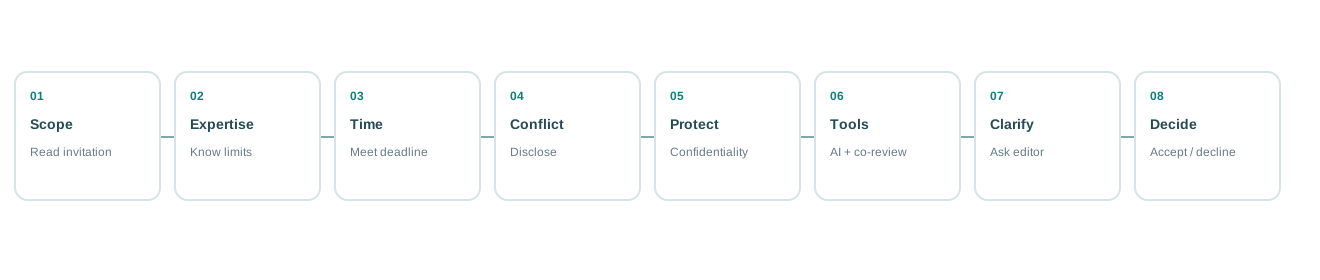
22. The 60-Second Acceptance Check
Before clicking Accept, ask: Is the central topic within my expertise? Can I evaluate the key methods? Do I have enough time? Is there a financial, professional, institutional or personal conflict? Can I protect confidentiality? Can I comply with the journal’s AI and review-model rules?
If every answer is satisfactory, acceptance is reasonable. If one answer is uncertain, clarify it with the editor. If a material problem cannot be managed, decline promptly.
This short check is a final safeguard, not a substitute for professional judgment.
23. Treata Standard Before Accepting a Review
Treata expects reviewers to make an active decision about competence, independence, confidentiality and availability before accepting. Relevant competing interests and limitations in expertise should be disclosed rather than managed privately.
Unpublished material remains confidential from the invitation onward. Co-reviewing and AI-assisted processing must comply with journal rules and must never bypass confidentiality obligations.
When an invitation is unsuitable, prompt decline is professional conduct. When uncertainty can be resolved, communicate with the editor before proceeding.
Continue the reviewer pathway
Related reviewer guides
Canonical Treata standards