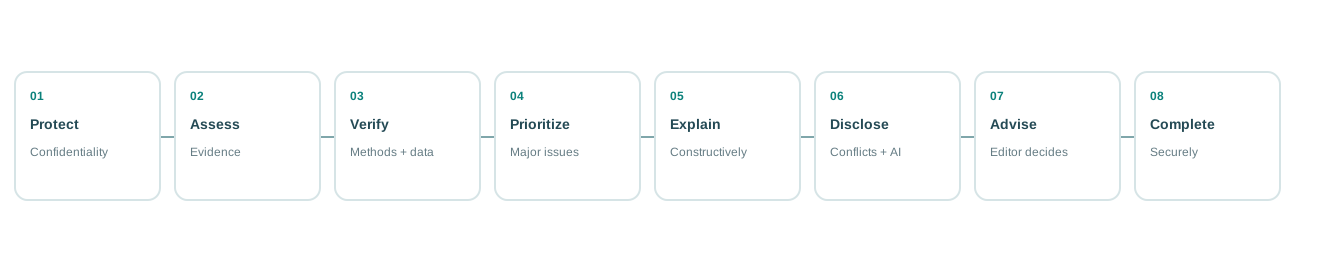
1. Responsibility Begins With the Accepted Assignment
Once a reviewer accepts an invitation, the task becomes a professional commitment to the editor, authors and scholarly record. The reviewer should perform the agreed assessment with appropriate care, independence, confidentiality and timeliness.
The role is advisory. Reviewers contribute specialist reasoning and evidence assessment; editors remain responsible for editorial decisions. A reviewer should therefore explain the basis of important concerns rather than relying on authority or recommendation labels.
If circumstances change after acceptance—such as a newly recognized conflict, an unexpected limitation in expertise or inability to meet the deadline—the reviewer should inform the editor promptly.
2. Review Within the Scope of Your Expertise
Responsible review requires knowing where your expertise is strong and where it is limited. Evaluate the areas you can judge competently and tell the editor when a central method or specialist domain falls outside that scope.
Do not compensate for uncertainty with overly confident criticism. When additional statistical, methodological, clinical or technical expertise is needed, explain why rather than attempting to imitate specialist authority.
Multidisciplinary peer review works best when reviewers provide complementary expertise. A focused, accurate assessment is more valuable than a comprehensive-looking report built on unsupported claims.
3. Preserve Independence Throughout the Review
The review should be based on the manuscript’s scientific content and the journal’s criteria, not on commercial interests, professional rivalry, institutional prestige, personal relationships or desired study outcomes.
Independence also means resisting pressure to support or oppose a manuscript because its findings confirm or challenge prevailing views. Negative, null or unexpected findings should be assessed by the same standards of validity and reporting.
If a relationship or activity emerges that could bias the review, disclose it to the editor. Do not privately decide that a material conflict can simply be ignored.
4. Maintain Strict Confidentiality
Treat the manuscript and associated files as privileged, unpublished material. Do not discuss the work publicly, circulate it to unauthorized colleagues, or use unpublished ideas, methods, data or results for personal advantage.
Confidentiality extends to supplementary files, reviewer correspondence, editorial messages and information about the manuscript’s status. Store review material securely and follow the journal’s instructions regarding retention or deletion after the review.
Publication of the article does not automatically authorize disclosure of confidential editorial correspondence or another participant’s identity.
5. Protect Confidential Material When Using Digital Tools
Cloud services, translation systems, reference tools, note-taking platforms and generative-AI systems may transmit manuscript content outside the reviewer’s controlled environment. Reviewers should understand the journal’s rules before placing confidential material into any external service.
Where confidentiality cannot be assured, manuscript content should not be uploaded. If AI use is permitted, the reviewer remains responsible for checking accuracy, bias and appropriateness and should disclose use when required by the journal.
Convenience does not override confidentiality.
6. Complete the Review Within the Agreed Time
Timeliness is an ethical and operational responsibility because delayed reviews postpone editorial decisions and can affect authors’ ability to communicate their research.
If an unforeseen delay occurs, contact the editorial office early. The editor can then extend the deadline, reassign the manuscript or make another arrangement.
Do not hold a manuscript while repeatedly postponing work. When completion is no longer realistic, say so promptly.
7. Read the Complete Material Provided for Review
A responsible assessment should consider the manuscript together with relevant tables, figures, supplementary files, protocols, reporting checklists, data-availability information and other materials supplied by the journal.
Important methodological details or discrepancies may exist outside the main text. Conversely, do not criticize authors for information that is already clearly provided in supplementary material you did not read.
If a necessary file appears to be missing, ask the editor rather than assuming the authors omitted it.
8. Assess the Research Question Before the Presentation
First determine what the manuscript asks, why the question matters, what design was used and what evidence supports the principal claim. This creates a scientific frame for the review.
Presentation quality matters, but stylistic imperfections should not obscure assessment of validity. Likewise, polished writing should not substitute for sound methods or reliable evidence.
Separate concerns about scientific validity from concerns about clarity, organization and language so the editor can understand their relative importance.
9. Evaluate Methods in Relation to the Claim
Ask whether the study design, population, measurements, interventions or exposures, outcomes and analytical approach can answer the stated research question. Consider bias, confounding, missing data, sample-size reasoning and the distinction between prespecified and exploratory analyses where relevant.
Do not require unnecessary methods simply because they are common in your own work. Requests should address credible threats to validity, reproducibility or interpretation.
When a methodological problem is potentially correctable by clarification or reanalysis, state what information is needed. When it fundamentally limits the claim, explain why.
10. Evaluate Statistical Evidence Proportionately
Review numerical consistency, effect estimates, uncertainty, denominators, missing observations and the appropriateness of major analyses. Avoid treating statistical significance as the sole measure of importance or validity.
Do not request additional analyses without a scientific reason. Unnecessary subgroup analyses, alternative models or repeated testing can create rather than resolve interpretive problems.
If the central statistical method is beyond your expertise, tell the editor and focus your report on the areas you can assess reliably.
11. Reconcile Methods, Results, Tables and Figures
The manuscript should tell a coherent scientific story across sections. Check whether outcomes described in Methods appear in Results, whether denominators remain consistent, and whether tables, figures, abstract and text agree.
When inconsistencies occur, identify their location and consequence. A precise observation—such as conflicting participant counts—is more useful than a general statement that the manuscript is confusing.
Image or data irregularities may warrant confidential escalation, but visible anomalies alone should not be presented as proof of misconduct.
12. Judge Conclusions Against the Evidence
Conclusions should remain within the limits of the design, population, measurements and uncertainty. Reviewers should identify causal language unsupported by observational designs, overgeneralization beyond the studied population and claims that exceed the reported results.
At the same time, reviewers should not force authors to adopt the reviewer’s preferred interpretation when several evidence-consistent interpretations are reasonable.
Explain the evidentiary reason for requested changes in interpretation.
13. Use Reporting Guidelines as Tools, Not Scores
Relevant reporting frameworks can help identify information needed to understand a study. Their value lies in improving transparency and completeness.
A completed checklist does not prove that the research is valid, and incomplete reporting does not automatically mean the underlying study was poorly conducted. Review both the science and its reporting.
When asking authors to address a reporting item, identify the missing information and why it matters instead of issuing a generic instruction to follow a named guideline.
14. Evaluate Ethics and Participant Protection
Reviewers should notice whether human or animal research includes appropriate ethics information and whether the reported conduct raises credible concerns about consent, privacy, participant protection, trial registration or animal welfare.
The reviewer’s role is not to conduct an institutional investigation. If information appears missing, contradictory or implausible, communicate the specific concern confidentially to the editor.
Do not request identifiable participant information unless the editor determines that verification is necessary and appropriate.
15. Consider Data, Code and Reproducibility
Assess whether data-availability statements, code information and reproducibility materials are consistent with the study and journal requirements. For computational work, sufficient details about software, models or analytical procedures may be necessary to evaluate the evidence.
Public release is not always appropriate. Privacy, consent, legal obligations and third-party restrictions may require controlled access or other safeguards.
Any confidential data or code supplied for review must be protected under the same obligations as the manuscript.
16. Write Constructive, Evidence-Based Criticism
A strong review identifies what is wrong or unclear, why it matters, and—where feasible—what would resolve the concern. Comments should help the editor evaluate the manuscript and help authors understand the scientific issue.
Avoid sarcasm, humiliation and unsupported declarations. Direct criticism is appropriate when warranted, but it should address the work rather than the authors’ presumed ability, motives or background.
Do not inflate the report with minor preferences to make it appear more substantial.
17. Prioritize Major and Minor Concerns
Major comments should focus on issues affecting validity, ethics, interpretation, reproducibility or the editorial decision. Minor comments should address correctable reporting, clarity or presentation issues.
Prioritization helps authors respond efficiently and helps editors distinguish fundamental problems from refinements.
If a concern is decisive in your recommendation, make that clear and explain the reasoning rather than burying it among many small comments.
18. Keep Comments to Authors and Editor Coherent
The recommendation to the editor should be supported by the scientific concerns described in the report. Do not send encouraging comments to authors while privately recommending rejection for reasons never explained, unless the information is legitimately confidential.
Confidential comments are appropriate for conflicts, integrity concerns, sensitive contextual information or editorial issues that should not be disclosed directly.
They should not become a place for hostile or unsubstantiated statements.
19. Do Not Treat the Recommendation as the Decision
Reviewers advise; editors decide. Avoid telling authors that their paper will be accepted or rejected, and do not assume the editor must follow your recommendation.
Editorial decisions can incorporate journal scope, other reviews, specialist assessments and considerations not visible to an individual reviewer.
The reviewer’s most valuable contribution is transparent reasoning that allows the editor to make an informed decision.
20. Avoid Coercive Citation Practices
Suggest references only when they are genuinely relevant to understanding, contextualizing or correcting the manuscript. Explain the relevance of important suggested citations.
Do not pressure authors to cite your work, the journal, your colleagues or a preferred literature merely to increase citation counts or visibility.
Citation requests should serve the manuscript and scholarly context, not the reviewer’s interests.
21. Report Integrity Concerns Through the Editor
Possible plagiarism, fabricated or falsified data, image manipulation, duplicate publication, undisclosed conflicts or peer-review manipulation should be reported confidentially with the specific observations that triggered concern.
Do not contact the authors’ institution, employers, funders or social media audiences independently as part of the journal review. The editor should coordinate appropriate follow-up.
Distinguish a signal requiring assessment from a conclusion of misconduct.
22. Do Not Appropriate Unpublished Ideas
Knowledge obtained through peer review must not be used to advance the reviewer’s research, commercial interests, patents, grant applications or publications before the work becomes legitimately available.
This duty applies whether the manuscript is accepted, revised, rejected or withdrawn.
If the manuscript creates a direct competitive situation that makes independent review difficult, notify the editor.
23. Handle Co-Reviewing Transparently
Do not secretly delegate the manuscript to a trainee or colleague. Obtain editorial permission where required and ensure every participant understands confidentiality.
Contributors to the review should be acknowledged according to journal policy. The invited reviewer should supervise the work and remain accountable for the submitted report.
Co-reviewing should be a transparent educational or expertise-enhancing practice, not invisible outsourcing.
24. Take Responsibility for Any Permitted AI Assistance
If the journal permits AI-assisted tools, their output should be treated as unverified assistance rather than expert judgment. AI can generate plausible but incorrect, incomplete or biased criticism.
Reviewers remain responsible for every claim, citation and recommendation submitted under their name. Any required disclosure of AI use should be complete and accurate.
AI should not be used to replace the reviewer’s independent reading and reasoning.
25. Approach Revised Manuscripts With Continuity
When reviewing a revision, compare the editor’s decision, previous comments, author response and revised manuscript. Determine whether the underlying concern was addressed, not merely whether wording changed.
Avoid introducing new optional demands simply because another round is available. New major concerns may legitimately emerge, but review should converge when prior issues have been resolved.
A reasoned disagreement from authors should be evaluated on its merits.
26. Maintain Professional Communication
Communication about the manuscript should occur through the journal unless the editor explicitly authorizes another route. Reviewers should not contact authors directly about the submission.
Questions about deadlines, missing materials, conflicts, review scope or integrity concerns should be directed to the editorial office.
Professional communication protects confidentiality and creates a documented editorial record.
27. Complete the Assignment Responsibly
Before submitting, reread the report for internal consistency, tone and prioritization. Confirm that confidential information is in the correct field and that the recommendation is supported by the stated concerns.
Follow journal instructions regarding deletion or retention of manuscript files after the review. Do not keep copies for personal use when policy requires their destruction.
If the journal later asks a legitimate question about your report, respond within the bounds of confidentiality and available records.
28. Treata Reviewer Responsibility Standard
Treata expects reviewers to act as independent, confidential, competent and timely advisers to editors. Reviews should evaluate evidence proportionately, distinguish scientific problems from stylistic preferences, and communicate major concerns clearly and respectfully.
Reviewers must disclose relevant competing interests, protect unpublished material, avoid coercive citation and personal advantage, use AI only under applicable journal rules, and route integrity concerns through the editorial process.
Journal-specific instructions may add scoring forms, recommendation categories or specialist requirements. Those requirements operate alongside Treata’s publisher-wide peer-review and research-integrity standards.
Reviewer resources
Continue the reviewer pathway
Canonical Treata standards