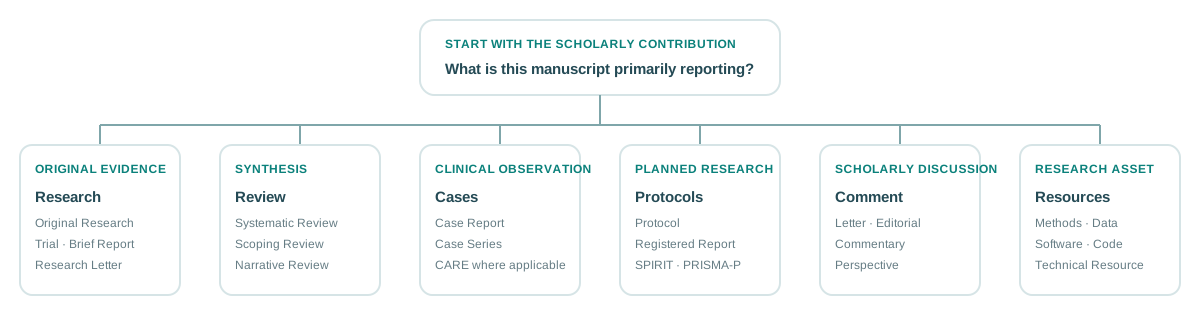
How Article Type Affects Editorial Assessment
Article type tells editors and readers what kind of scholarly claim is being made. It affects expected structure, reporting standards, ethics documentation, peer-review expertise, data expectations, length and supplementary material. Authors should select the category that reflects the actual work, not the category perceived as easier to publish.
Article Type Does Not Override Research Ethics
Ethics requirements arise from what was done with participants, animals, data, specimens and interventions. Renaming a clinical investigation as a Letter, Brief Report or Case Series does not remove an ethics, consent or registration obligation.
Reporting Guidelines Follow the Study Design
A journal’s article label and the methodological reporting framework are related but not identical. An Original Research article may need CONSORT, STROBE, STARD, TRIPOD, ARRIVE or another guideline depending on its design. EQUATOR can help identify relevant health-research reporting guidance.
Data and Code Expectations Follow the Evidence
Short formats do not automatically justify withholding data, code or analytic details. Data availability should reflect ethical, legal and journal requirements, while code/materials expectations should reflect what is necessary to assess and reproduce the work.
Commissioned and Invitation-Only Content
Reviews, editorials, commentaries and special contributions may be commissioned or require prior editorial approval. An invitation does not waive authorship, disclosure, integrity, citation or conflict-of-interest requirements.
Article-Type Changes During Review
Editors may conclude that a manuscript fits another category. Any change should preserve the scientific record and applicable ethics/reporting requirements. Authors should not agree to a category change that would make essential methodological information disappear.
Journal-Specific Configuration
Treata journals may support different article types and impose different limits, templates, checklists, APC settings and file requirements. The presence of an article type in this publisher-level guide does not mean every Treata journal accepts it.
Article type
Original Research
Purpose: Reports a defined research question using original data, observations, experiments, analyses, or other primary research material.
Structure & content
Use a structure appropriate to the discipline, commonly Introduction, Methods, Results and Discussion (IMRaD). Clearly identify design, setting, participants or materials, outcomes, measurements, analysis, ethics, results and limitations.
Ethics & oversight
Ethics approval, consent, registration, permits or animal oversight apply according to the underlying research—not merely because the manuscript is called Original Research.
Reporting guidance
Use the reporting guideline that matches the actual design, such as CONSORT for randomized trials, STROBE for observational studies, STARD for diagnostic accuracy, TRIPOD for prediction models, COREQ/SRQR for qualitative work, ARRIVE for animal research, or another applicable framework.
Data / code expectations
Prepare a data availability statement and, where relevant, code/materials availability. Journal-specific data sharing requirements may vary.
Submission differences
Submission commonly requires a main manuscript, title page, figures/tables, reporting checklist where applicable, ethics/registration information, disclosures and supporting files required by the journal.
Article type
Randomized Clinical Trial
Purpose: Reports prospectively assigned health interventions intended to evaluate effects on health-related outcomes.
Structure & content
The manuscript should clearly report trial design, allocation, randomization, concealment, blinding where applicable, interventions, outcomes, sample-size planning, participant flow, harms and statistical analysis.
Ethics & oversight
Prospective ethics approval and informed consent requirements generally apply. Registration timing and registry information must be reported accurately.
Reporting guidance
CONSORT and relevant CONSORT extensions are central reporting references; journal instructions may impose additional requirements.
Data / code expectations
Authors should preserve protocol, statistical analysis plan, registration history and underlying trial data. Data-sharing expectations can be stronger for clinical trials.
Submission differences
Submission may require the CONSORT checklist and flow diagram, trial registration number, protocol/SAP, data-sharing statement and additional declarations.
Article type
Systematic Review & Meta-analysis
Purpose: Uses explicit, reproducible methods to identify, select, appraise and synthesize evidence addressing a focused question.
Structure & content
Report eligibility criteria, information sources, complete search methods, selection, data extraction, risk-of-bias assessment, synthesis methods, heterogeneity, reporting-bias assessment and certainty where applicable.
Ethics & oversight
Systematic reviews usually do not require participant ethics approval when analyzing published aggregate literature, but reviews using individual participant data, confidential datasets or other controlled sources can create additional governance obligations.
Reporting guidance
PRISMA 2020 and relevant extensions should be considered; specialized review types may require additional guidance.
Data / code expectations
Share search strategies, extraction forms, analytic code, derived datasets and other reproducibility materials when legally and ethically possible.
Submission differences
Submission may require a PRISMA checklist/flow diagram, registration or protocol information, full search strategies, supplementary analyses and data/code statements.
Article type
Scoping Review
Purpose: Maps the extent, characteristics, concepts or evidence landscape of a broad topic rather than necessarily estimating a single intervention effect.
Structure & content
State the review question, eligibility criteria, information sources, search, selection, charting process and method used to synthesize or map evidence.
Ethics & oversight
Ethical requirements depend on source material. Use of non-public or identifiable data can introduce obligations not present in a conventional literature review.
Reporting guidance
PRISMA-ScR is a common reporting framework.
Data / code expectations
Search strategies and charted data should be documented sufficiently for transparency.
Submission differences
Do not label a narrative overview as a scoping review merely because it covers a broad field; the methods should be systematic and reproducible.
Article type
Narrative Review
Purpose: Provides a scholarly, critical synthesis and interpretation of a topic without necessarily using the full methods of a systematic review.
Structure & content
Define the review’s purpose, scope and organizing framework. Where literature searching or selection was structured, describe the approach transparently without implying systematic-review methods that were not used.
Ethics & oversight
Ethics approval is generally not required for synthesis of public published literature, but use of unpublished, identifiable or controlled information may alter this.
Reporting guidance
No single reporting guideline applies universally to all narrative reviews; discipline-specific guidance and journal requirements should be followed.
Data / code expectations
Authors should represent important competing evidence fairly and avoid selective citation designed to support a predetermined conclusion.
Submission differences
Some journals commission narrative reviews or require prior editorial approval; verify eligibility before submission.
Article type
Brief Report / Short Communication
Purpose: Presents a focused, complete research finding in a concise format when the contribution does not require a full-length article.
Structure & content
A shorter article is not a lower-integrity article. Methods, ethics, key results, uncertainty and limitations must remain sufficient for assessment.
Ethics & oversight
The same ethics, consent, registration and integrity obligations apply as they would to the underlying study if reported as a full Original Research article.
Reporting guidance
Apply the reporting guideline appropriate to the study design, even when the journal allows a shortened presentation.
Data / code expectations
Data and code expectations should be determined by the research and journal policy rather than by article length.
Submission differences
Expect tighter word, table, figure and reference limits. Supplementary material should not be used to hide information essential to evaluating validity.
Article type
Case Report
Purpose: Describes one patient or a small number of patients when the case offers a meaningful clinical, diagnostic, therapeutic, safety or educational contribution.
Structure & content
Present relevant patient information, timeline, diagnostic assessment, intervention, follow-up, outcomes and a focused discussion of the case’s significance.
Ethics & oversight
Publication consent and privacy protection are central. Consent to treatment or participation is not automatically the same as consent to publish identifiable clinical information.
Reporting guidance
CARE is a widely used reporting guideline for case reports.
Data / code expectations
Data sharing is usually limited by privacy and identifiability. Do not promise public release of patient-level material when consent or law does not permit it.
Submission differences
Clinical photographs, pedigrees, imaging, rare combinations of details and geographic/time information require particular privacy review.
Article type
Case Series
Purpose: Describes multiple patients or cases sharing a condition, exposure, intervention or outcome, generally without a formal comparison group.
Structure & content
Define case identification, inclusion criteria, setting, period, measurements, follow-up and analytic approach. Explain whether cases were consecutive or selectively included.
Ethics & oversight
Ethics review requirements vary by jurisdiction, design and use of identifiable information. Do not assume that calling work a 'case series' makes it exempt.
Reporting guidance
Use applicable case-report or observational reporting guidance as appropriate to the design and journal.
Data / code expectations
Data sharing may be constrained by re-identification risk, especially for rare conditions or small cohorts.
Submission differences
Distinguish a descriptive case series from a cohort study when the sampling and analytical design support the latter.
Article type
Research Letter
Purpose: Communicates a compact original research finding in a highly constrained format, often with limited text, figures/tables and references.
Structure & content
Despite its length, a Research Letter should identify the research question, essential methods, principal results and appropriate interpretation.
Ethics & oversight
Research ethics, consent, registration and data obligations follow the underlying study.
Reporting guidance
Use the applicable study-design reporting principles even if a full checklist is not requested.
Data / code expectations
Check whether the journal treats Research Letters as peer-reviewed original research and whether supplementary files are allowed.
Submission differences
Do not omit essential limitations or methodological information simply to meet a word count; select this format only when the work can be evaluated responsibly within it.
Article type
Letter to the Editor / Correspondence
Purpose: Provides scholarly comment, critique, clarification or a concise observation, often in response to recently published work.
Structure & content
Identify the article or issue being discussed and focus on a specific, evidence-based point. Separate factual correction from difference in interpretation.
Ethics & oversight
Do not disclose confidential peer-review information or identifiable patient information. Ethical obligations still apply to any new data introduced in the letter.
Reporting guidance
Formal reporting guidelines are uncommon for pure correspondence, but any original study data should be reported according to their design.
Data / code expectations
Letters may have strict deadlines after publication, short word/reference limits and limits on authors or figures.
Submission differences
Editors may invite the authors of the original article to respond. Keep criticism directed at methods, evidence and interpretation rather than individuals.
Article type
Editorial / Commentary
Purpose: Offers expert interpretation, context, perspective or policy/scientific discussion rather than a conventional report of original research.
Structure & content
State the issue clearly, distinguish evidence from opinion, cite supporting literature and disclose relevant relationships.
Ethics & oversight
Editorials containing new participant-level research or identifiable material may trigger research ethics or consent requirements despite the article label.
Reporting guidance
No universal reporting guideline applies, but factual claims and citations should remain verifiable.
Data / code expectations
Editorials and commentaries are frequently commissioned or invitation-only. Check the journal’s policy before preparing an unsolicited submission.
Submission differences
Editorial position must not be presented as independent evidence. Authors should make uncertainty and contested interpretations visible.
Article type
Viewpoint / Perspective
Purpose: Develops a reasoned scholarly position, conceptual argument or forward-looking interpretation on an important research or practice issue.
Structure & content
Build the argument from transparent premises and relevant evidence. Address credible alternatives rather than selecting only supportive citations.
Ethics & oversight
Ethics requirements depend on whether new human, animal or controlled data are introduced.
Reporting guidance
Reporting frameworks may be topic-specific rather than article-type-specific.
Data / code expectations
Clearly distinguish recommendations, hypotheses and opinion from empirical findings.
Submission differences
Check whether the journal distinguishes Viewpoint, Perspective and Commentary and whether submission is invited.
Article type
Protocol
Purpose: Describes a planned study or review before its principal results are known, enabling transparency about intended methods.
Structure & content
Report rationale, objectives, design, eligibility, interventions/exposures, outcomes, sample-size planning, data management, analysis, monitoring and dissemination as relevant.
Ethics & oversight
For research involving humans or animals, appropriate ethics/oversight status must be reported. Clinical trials should provide accurate registry information.
Reporting guidance
SPIRIT is central for clinical trial protocols; PRISMA-P is commonly used for systematic-review protocols. Other designs may have specialized guidance.
Data / code expectations
Protocol versions, amendments, statistical plans and related materials should be preserved and made accessible when appropriate.
Submission differences
A protocol article should not be rewritten retrospectively to make completed work appear prospectively planned.
Article type
Registered Report
Purpose: Separates peer review of the research question and methods from evaluation of the completed results, typically through staged editorial assessment.
Structure & content
Stage 1 usually contains rationale, hypotheses/questions, methods and analysis plan before outcomes are known; Stage 2 reports the completed study against the approved plan.
Ethics & oversight
Ethics approval and registration requirements depend on the research and must align with the journal’s staged process.
Reporting guidance
Reporting guidelines still apply to the final study design.
Data / code expectations
Preserve approved protocol versions and document deviations transparently.
Submission differences
Availability is journal-specific. Authors must follow the particular Registered Report workflow and timing requirements.
Article type
Methods / Methodology Article
Purpose: Describes a new or materially improved research method, protocol, instrument, workflow, assay, computational approach or validation.
Structure & content
Explain the problem addressed, method in sufficient detail, validation strategy, comparators or benchmarks, performance, limitations and intended use.
Ethics & oversight
Ethics requirements depend on the validation data and materials used.
Reporting guidance
Use method-specific reporting standards where available; validation studies may also fall under design-specific guidelines.
Data / code expectations
Code, protocols, reagents, datasets, calibration materials or implementation details can be central to reproducibility and should be shared when permissible.
Submission differences
A Methods article should demonstrate why the method is useful and how its performance was assessed rather than functioning as a product description.
Article type
Data Note / Data Descriptor
Purpose: Describes a dataset, its provenance, collection, structure, quality control and reuse potential rather than centering a conventional hypothesis-driven result.
Structure & content
Document data origin, sampling, variables, processing, quality assurance, file formats, metadata and known limitations.
Ethics & oversight
Confirm consent, privacy, governance, licensing and rights permit the proposed level of data sharing.
Reporting guidance
Use repository and metadata standards appropriate to the field; discipline-specific data-reporting frameworks may apply.
Data / code expectations
A persistent repository record and clear reuse license are often central to this article type.
Submission differences
Do not publish identifiable or restricted data merely because a Data Note format expects openness; use controlled access or another lawful model when necessary.
Article type
Software / Code Article
Purpose: Describes research software, an analytical package, computational workflow or other scholarly code contribution.
Structure & content
Explain purpose, architecture or methods, installation, dependencies, validation, examples, limitations and maintenance status.
Ethics & oversight
Ethical requirements arise if validation uses controlled human/animal data or if the software creates privacy/security risks.
Reporting guidance
Provide repository, version or release identifier, documentation and license when possible.
Data / code expectations
Separate claims about software performance from marketing. Benchmarking should be reproducible and appropriately compared.
Submission differences
Check whether the journal requires archival release, DOI, open-source licensing, tests or executable examples.
Article type
Replication / Reproducibility Study
Purpose: Tests whether a previous finding, analysis, experiment or computational result can be reproduced or replicated.
Structure & content
Define the target claim, what constitutes replication or reproduction, deviations from the original method, and the criteria used to interpret consistency.
Ethics & oversight
Ethics requirements follow the new study or reused data.
Reporting guidance
Use the reporting guideline appropriate to the replicated design and provide transparent comparison with the original work.
Data / code expectations
Share code, protocols and data where possible because procedural transparency is especially important.
Submission differences
Failure to replicate should not be framed as misconduct by the original authors without separate evidence.
Article type
Negative / Null Results Article
Purpose: Reports methodologically informative research in which prespecified effects were absent, inconclusive or contrary to expectation.
Structure & content
Report the design and analysis with the same completeness expected for positive findings. Focus on effect estimates and uncertainty rather than treating a threshold as proof of 'no effect'.
Ethics & oversight
Ethical and registration obligations are unchanged by the direction of results.
Reporting guidance
Apply the appropriate design-specific reporting guideline.
Data / code expectations
Preserve and share data/code according to the same standards as other research.
Submission differences
Do not reframe an underpowered or poorly measured study as definitive evidence of absence.
Article type
Research Resource / Technical Note
Purpose: Describes a reusable scientific resource, technical implementation, collection, database, instrument, workflow or infrastructure contribution.
Structure & content
Explain construction, provenance, validation, access, intended use, maintenance and limitations.
Ethics & oversight
Address ethics, consent, privacy, intellectual property and governance for any underlying data or materials.
Reporting guidance
Use discipline-specific standards for resource description and metadata where available.
Data / code expectations
Provide persistent access information and versioning when feasible.
Submission differences
Distinguish scholarly validation from a service announcement or commercial promotion.
Related author guidance
Prepare the selected article type
Canonical standards