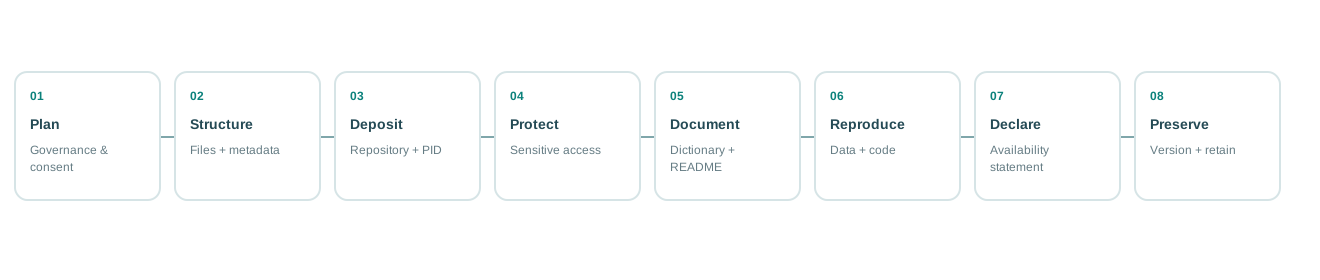
1. Purpose: Data as Part of the Scholarly Record
Research data are not merely files stored behind a manuscript. They are part of the evidentiary record that allows findings to be understood, evaluated, verified and, where appropriate, reused. Treata therefore treats data management, availability and reproducibility as publication responsibilities that begin during research planning rather than after peer review.
The appropriate level of sharing depends on the research context. Some datasets can be openly deposited; others contain sensitive human information, contractual restrictions, protected cultural knowledge, commercial constraints or third-party rights. Responsible openness means maximizing legitimate access without violating participant protections, law, consent, ethics approvals or binding data-use conditions.
Authors should be able to explain what data support the reported results, where those data are held, what documentation is available, who can obtain access, under what conditions, and which restrictions prevent broader sharing. A data availability statement should accurately summarize that reality rather than function as generic boilerplate.
2. Plan Data Management Before Data Collection
A reproducible publication is easier to produce when data management is designed into the project. Before collection begins, define the expected data types, file formats, naming conventions, storage locations, backup arrangements, access permissions, documentation practices, version control, retention period and intended sharing route.
Human-participant projects should align the data-management plan with the ethics application and consent materials. Promising open sharing in a publication is inappropriate when the approved consent or governance framework does not permit it. Conversely, vague consent language should not be used later as an excuse for avoidable non-sharing if responsible sharing could have been planned prospectively.
Funders, institutions, registries and disciplines may impose additional requirements. Authors should identify these early enough to choose a suitable repository, budget for curation or storage, and prepare metadata and documentation while the research team still understands the dataset in detail.
3. FAIR Principles: Findable, Accessible, Interoperable and Reusable
The FAIR principles provide a useful design framework for research outputs. Findable data should have sufficiently rich metadata and durable identifiers; accessible data should have a defined and workable access mechanism; interoperable data should use appropriate formats, vocabularies and structures; reusable data should be documented well enough for others to understand provenance, meaning and permitted use.
FAIR does not mean that every dataset must be publicly downloadable. Sensitive data can still be FAIR when metadata are discoverable and a controlled, transparent access process exists. “Accessible” can therefore mean access under legitimate conditions rather than unrestricted public release.
Authors should avoid claiming that data are FAIR simply because a ZIP file was uploaded somewhere. Reusability depends on documentation, context, variable definitions, provenance, licensing and preservation as much as on the existence of a download link.
4. Define the Data That Support the Article
The publication record should distinguish raw source data, processed data, analysis-ready datasets, derived variables and the minimum data underlying figures, tables and statistical results. Different studies may require different layers to support verification.
Sharing only a polished spreadsheet containing final plotted values may be insufficient when the manuscript depends on substantial cleaning, exclusions, transformations or modeling that cannot be reconstructed. Conversely, depositing every intermediate temporary file can create noise without improving reproducibility.
Authors should identify the smallest coherent package that allows a qualified researcher to understand how the reported evidence was generated. That package may include source or analysis data, data dictionaries, protocols, statistical analysis plans, processing scripts, code, README files and provenance documentation.
5. Data Availability Statements: What They Must Tell the Reader
A useful Data Availability Statement answers practical questions: What data support the findings? Are they openly available, controlled, restricted, third-party, or unavailable? Where are they located? Is there a DOI, accession number or other persistent identifier? What conditions apply? When will the data become available, and for how long where relevant?
If only part of the dataset can be shared, identify what is available and what is restricted. If access requires an application, name the responsible repository or data access mechanism and describe the eligibility or review process at a level that lets readers understand whether access is realistically possible.
The statement should match the actual repository record and manuscript. A DOI that resolves to an empty landing page, an inaccessible private folder, or files unrelated to the published analysis does not satisfy the purpose of data availability.
6. When “Available on Request” Is Acceptable—and When It Is Not
“Available from the corresponding author on reasonable request” is often weaker than repository-based sharing because access depends on an individual remaining reachable, willing and able to retrieve the data. It also provides limited transparency about eligibility, response time, preservation and long-term availability.
The phrase may be acceptable when a legitimate reason prevents open deposition and no suitable controlled repository exists—for example, certain sensitive datasets, small legacy datasets governed by institutional review, or materials requiring case-by-case legal or ethical assessment. In such cases, the statement should explain the restriction and, where possible, identify who evaluates requests, what criteria apply and what documentation is needed.
It is generally inadequate when used merely for convenience, when a stable repository is readily available, when funder or journal policy requires deposition, when the corresponding author lacks authority to release the data, or when prior experience shows that requests cannot realistically be fulfilled. Authors should never promise “on request” access that consent, contracts, law or data ownership actually prohibit.
7. Choosing a Repository and Avoiding Fragile Storage
Prefer established repositories that provide durable preservation, stable landing pages, persistent identifiers, metadata, access controls where needed, versioning and clear terms of use. A domain-specific repository is often preferable when it understands the data type and community standards; a reputable generalist repository can be appropriate when no suitable disciplinary option exists.
Personal websites, temporary cloud links, email attachments and ordinary file-sharing folders are poor substitutes for archival repositories because links can expire, permissions can change and provenance may be unclear. Supplementary files hosted by a journal can be useful for small supporting materials but may not provide the metadata, access management or reuse features of a dedicated data repository.
Repository choice should also respect funder, institutional, national or disciplinary requirements. Treata does not treat one repository as universally correct; suitability depends on data type, preservation, access model, governance and community practice.
8. Persistent Identifiers, Accession Numbers and Data Citation
Deposited datasets should use persistent identifiers when available, such as a DOI or repository accession. Persistent identifiers make the dataset citable, discoverable and distinguishable from similarly named files or later versions.
The manuscript should cite datasets as research outputs where appropriate, not hide them only in a URL inside the Data Availability Statement. A data citation should identify the creator or responsible group, dataset title, repository, version or date where relevant, and persistent identifier according to journal style.
Secondary analyses should cite the source dataset and repository accurately. For controlled datasets, the accession or study identifier can provide scholarly credit and traceability without exposing restricted participant-level information.
9. Metadata, README Files and Data Dictionaries
Data without documentation can be technically available yet scientifically unusable. Every deposited package should include enough metadata to explain what the files contain, how they relate to the study, how they were generated and what software or conventions are needed to interpret them.
A README should describe directory structure, file purpose, processing order, dependencies and important limitations. A data dictionary should define variables, units, coding schemes, missing-value conventions, category labels, transformations and derived variables. For longitudinal or multi-site datasets, explain visit structure, site identifiers and harmonization procedures.
Machine-readable metadata and recognized disciplinary vocabularies improve interoperability. Human-readable documentation remains essential because a future user should not need private knowledge from the original research team to interpret basic fields.
10. File Formats, Structure and Versioning
Use open, well-documented and non-proprietary formats where practical, especially for long-term preservation. Proprietary formats may still be necessary for specialized instruments or software, but authors should consider exporting reusable representations alongside originals when this does not destroy important information.
Keep file names, directory structures and versions systematic. The dataset supporting the accepted manuscript should be identifiable as a stable version rather than an undocumented live folder that continues to change.
When a dataset is corrected or expanded after publication, use repository versioning where possible and preserve the relationship between the version cited by the article and later releases. Silent replacement can undermine reproducibility because readers can no longer determine which data generated the published results.
11. Code, Software and Computational Reproducibility
When results depend materially on scripts, statistical code, notebooks, workflows, software or custom algorithms, data sharing alone may not be enough for reproducibility. Authors should make the relevant computational materials available when legally and ethically possible and when permitted by journal policy.
Code packages should identify software versions, dependencies, environment requirements, random seeds where relevant, expected inputs and the sequence needed to reproduce key outputs. A repository containing undocumented scripts with hard-coded local paths is technically shared but practically difficult to reproduce.
If code cannot be shared because of licensing, security, proprietary restrictions or other legitimate constraints, explain the limitation and provide as much methodological detail as possible. Authors should distinguish custom code they control from third-party software they are not legally entitled to redistribute.
12. Reproducibility Packages: Linking Data, Code and Outputs
A strong reproducibility package connects the manuscript to the exact materials used to generate its results. The package can include an analysis-ready dataset, data dictionary, preprocessing scripts, analysis code, model specifications, figure-generation scripts, computational environment information and a README describing execution order.
The goal is not necessarily one-click reproduction in every discipline. The goal is to make the analytical path inspectable and sufficiently documented that a qualified researcher can understand how inputs became published outputs.
Before submission, teams should test the package outside the original analyst’s workstation when feasible. Missing files, undocumented dependencies, absolute file paths and unrecorded manual edits are common reasons apparently complete packages fail.
13. Sensitive Human Data: Privacy Comes Before Openness
Human-participant data should not be released openly merely to satisfy a general preference for data sharing. Consent, ethics approval, applicable privacy law, re-identification risk and community harms must be considered before deciding the access level.
Removing names is not always sufficient. Dates, geography, rare diagnoses, free text, images, genomic information and combinations of variables can permit re-identification. De-identification should therefore be risk-based rather than limited to deleting obvious direct identifiers.
When open sharing would create unacceptable risk, use a controlled-access repository or another governed mechanism if appropriate. The Data Availability Statement should explain the restriction without revealing additional sensitive information.
14. Controlled Access: Make Restrictions Real and Usable
Controlled access should protect legitimate interests without becoming a disguised refusal to share. A credible mechanism identifies the body that reviews requests, eligibility criteria, permitted uses, required agreements, security expectations and any limits imposed by consent or governance.
Repository-based controlled access is often more durable than ad hoc decisions by a single corresponding author. Access committees or institutional processes should apply documented criteria consistently and retain records of approvals where required.
Researchers receiving controlled data must comply with data-use agreements, security conditions and approved purposes. They should not attempt re-identification, redistribute restricted files to unauthorized users or extend use beyond the permissions granted.
15. Clinical Trial and Participant-Level Data
Clinical trial data require particular attention to consent, de-identification, trial registration and the relationship between the protocol, statistical analysis plan and data-sharing statement. Current ICMJE policy requires manuscripts reporting clinical-trial results in ICMJE journals to include a data-sharing statement, and trials beginning enrollment on or after 1 January 2019 to include a data-sharing plan in the trial registration.
A clinical-trial sharing statement should specify whether deidentified individual participant data will be shared, what data will be shared, whether documents such as the protocol or statistical analysis plan will be available, the timing and duration of access, and the criteria and mechanism for access.
Treata journals may apply comparable or additional requirements. Authors should ensure the manuscript, registry and repository do not contradict one another about what will be shared.
16. Genomic and Other Intrinsically Identifiable Data
Genomic data can remain sensitive even after conventional identifiers are removed because genetic information can be distinctive and can carry implications for relatives or communities. Consent, institutional certification, repository requirements and data-use limitations may determine whether access is open, registered or controlled.
For studies subject to the NIH Genomic Data Sharing framework, large-scale human genomic data are generally managed through designated repositories and controlled-access processes where appropriate. Users of controlled data must follow the applicable security and data-use conditions.
Authors should avoid treating genomic accession numbers as proof that every associated file is publicly accessible. The manuscript should state the actual access tier and any relevant conditions.
17. Biobanks, Specimens and Linked Data
Biological specimens are not interchangeable with digital datasets. Sharing specimens may involve consent, material-transfer agreements, finite resources, biosafety, export controls, governance committees and costs. Data derived from specimens may have different access conditions from the physical material itself.
Biobank studies should explain the source and governance of samples, relevant consent framework, access route and whether derived datasets can be shared independently. When specimens are linked to clinical or genomic data, the combined re-identification risk may be greater than either resource alone.
A Data Availability Statement should not promise access to specimens when the authors do not control the biobank’s approval process.
18. Third-Party, Licensed and Commercial Data
Authors may analyze data obtained from governments, companies, registries, platforms, data vendors or other research groups under terms that prevent redistribution. The manuscript should distinguish data the authors own or control from data obtained under license or access agreement.
Do not upload third-party data to a repository unless redistribution rights permit it. Instead, identify the original source and explain how qualified researchers can seek access under the same or comparable conditions, where such access is genuinely available.
“Third-party restrictions” should not be used as vague boilerplate. State the nature of the restriction sufficiently for readers to understand why the data cannot be deposited and whether an independent researcher has a realistic path to obtain them.
19. Secondary Data, Registries and Public Datasets
Secondary analyses should identify the original dataset, version or accession, access date where relevant, and the terms under which it was obtained. Authors should distinguish their derived analytical dataset from the source resource and describe transformations needed to reproduce the analysis.
Public availability does not eliminate attribution, licensing or ethical responsibilities. Dataset creators and repositories should receive appropriate credit, and researchers should comply with terms of use even when download does not require formal approval.
For controlled secondary data, publication should not disclose variables or small-cell information that violates the original access agreement or participant protections.
20. Data Licensing and Reuse Conditions
A data license or terms-of-use statement tells future users what they may do with a shared dataset. Where authors have authority to license the data, choose terms consistent with funder, institution, participant consent, third-party rights and repository policy.
Do not apply an open license to material that contains rights you do not control. Mixed datasets may require different treatment for original data, third-party content, software and documentation.
Licensing does not remove scholarly obligations. Users should still cite datasets appropriately, respect ethical restrictions and avoid misrepresentation even when a license permits broad reuse.
21. Retention, Preservation and Long-Term Stewardship
Data should be retained for the period required by applicable law, funders, institutions, ethics approvals, contracts and journal policy. Different data types can have different retention requirements, and “keep forever” is not always ethically or legally appropriate for identifiable information.
Preservation should include more than the raw files. Documentation, metadata, code, provenance and the relationship between dataset versions may be necessary to understand the published record years later.
Repository deposition can improve long-term stewardship, but authors should still retain appropriate source records and institutional documentation. A repository is not a substitute for responsible research record management.
22. Data Integrity, Provenance and Audit Trails
Authors should preserve enough provenance to explain where data came from and how they changed. Document cleaning, exclusions, corrections, transformations, recoding, merges and derived variables in a reproducible way.
Manual spreadsheet edits without an audit trail are a common source of irreproducibility. Where practical, perform transformations through scripted or otherwise documented workflows and preserve original source data separately from processed datasets.
If data errors are discovered after publication, assess whether the correction changes only the dataset, the article’s results, or both. Material changes to the scholarly record should be handled transparently rather than silently replacing files.
23. Data Access, Authorship and Sponsor Independence
Authors accountable for analysis and interpretation should have meaningful access to the data supporting the article. Current ICMJE recommendations emphasize authors’ ability to review supporting data and, in sponsored collaborations, explicit provision for data access in research agreements.
A sponsor, CRO or data owner may legitimately host the database, but responsible authors should not be reduced to endorsing analyses they cannot inspect. The manuscript and disclosure record should accurately describe access limitations and who performed the analysis.
Data availability to readers and data access by authors are separate questions. A dataset may be restricted from public sharing while responsible authors still have full analytical access; conversely, a public dataset does not prove that every listed author participated meaningfully in analysis.
24. Peer Review and Editorial Verification of Data
Editors and reviewers may assess whether the Data Availability Statement is plausible, whether repository links resolve, whether deposited materials correspond to the manuscript, and whether restrictions are justified. Journals may request underlying data or documentation when necessary to evaluate integrity concerns.
Data sharing does not transfer responsibility for checking every value to reviewers. Authors remain responsible for accuracy, completeness and compliance with participant protections.
If editors identify contradictions—for example, a statement promising open data while the repository is private—they may require correction before acceptance. Unresolved discrepancies can delay or prevent publication.
25. Final Reproducibility Audit Before Submission
Before submission, verify that repository records are public or appropriately controlled, persistent identifiers resolve, files open, metadata are complete, variable definitions match the manuscript, code runs as documented where feasible, and the cited dataset version is the one used for analysis.
Cross-check the Data Availability Statement against ethics and consent documents, funder requirements, registry entries, third-party agreements, licenses and sponsor contracts. Confirm that no statement promises access the authors are legally or ethically unable to provide.
A colleague not involved in the original analysis can perform a valuable usability test: can they understand what the files are, locate the analysis inputs, interpret variables and follow the documented path to major outputs?
26. Treata Research Data Standard
Treata expects authors to manage research data as part of the scholarly record; use appropriate repositories and persistent identifiers where possible; provide meaningful metadata and documentation; share code and reproducibility materials when relevant and permitted; protect sensitive or restricted data through proportionate governance; and write Data Availability Statements that accurately describe real access.
“Available on request” should not be the automatic default. It should be used only when a legitimate constraint makes repository-based sharing inappropriate or unavailable and when the stated request mechanism is genuine, authorized and reasonably durable.
Journal-specific instructions may define mandatory repositories, required statement templates, code-sharing expectations, retention periods, clinical-trial requirements or disciplinary standards. Those local settings operate in addition to Treata’s canonical Research Data & Data Availability Policy (TS-DATA-001).
Related author guidance
Connected author manuals
Canonical Treata standards