1. Why Disclosure Matters
Competing-interest disclosure is a transparency mechanism, not a declaration of guilt. Research can be methodologically sound even when authors have relevant relationships, and an author can have no financial relationship yet still hold professional or personal interests that readers would reasonably want to know. The purpose of disclosure is therefore to give editors, reviewers and readers enough context to judge the work for themselves.
Treata uses a broad concept of relevant relationships and activities. Authors should not disclose only what they personally believe has influenced them. A relationship can merit disclosure because it could reasonably be perceived as relevant to the research question, interpretation, product, intervention, organization or policy discussed. When relevance is uncertain, factual disclosure is generally preferable to silent self-exclusion.
Disclosure is also different from management. An editor may conclude that a disclosed interest requires no action beyond publication of the statement, or may use independent handling, additional review, recusal or another proportionate safeguard. Authors should provide the facts rather than attempting to predict or control the editorial response.
2. What Counts as a Competing Interest
Relevant interests can be financial, professional, institutional, personal or intellectual. Financial relationships commonly include employment, consulting, advisory work, equity, stock options, honoraria, paid testimony, royalties, patents, licensing arrangements, sponsored travel and other payments or benefits. In-kind support—such as equipment, drugs, devices, software, laboratory services, data access or professional writing—can also be relevant even when no money is paid directly to an author.
Non-financial interests deserve the same careful analysis. Leadership positions in professional societies, foundations, advocacy organizations or institutions; participation in guideline panels or advisory committees; active professional rivalries; close personal relationships; and strong public commitments directly connected to the manuscript may create a reasonable perception of competing interest. The fact that a role is unpaid does not automatically make it irrelevant.
Relevance depends on connection, timing and magnitude. A remote relationship with no plausible connection to the work may not require the same treatment as current employment by a manufacturer whose product is being evaluated. Authors should apply the target journal’s disclosure period and categories and should ask the editorial office when a material relationship falls into a grey area.
3. Employment, Consulting and Professional Roles
Current or recent employment should be disclosed when an employer has a meaningful interest in the subject of the manuscript. This applies not only to commercial companies but also, where relevant, to universities, hospitals, government bodies, professional societies, charities, advocacy organizations and other institutions. Authors should describe the relationship accurately rather than using vague wording such as “industry experience.”
Consulting and advisory work can remain relevant even when it did not fund the submitted study. Scientific consulting, strategic advice, service on advisory boards, steering committees or data-monitoring structures, paid educational activities and expert testimony should be considered separately. If a role was unpaid, the absence of payment can be stated without hiding the role itself.
Institutional authority is not a substitute for disclosure. Department chairs, society officers, foundation trustees, journal editors and other leaders remain subject to the same transparency principles. If an author holds an editorial role at the journal receiving the manuscript, that role should be disclosed and the author must not control the editorial handling of their own submission.
4. Equity, Intellectual Property and Commercial Interests
Ownership of shares, stock options, founder interests or other equity in an entity connected to the research can create a direct financial stake in how findings are interpreted. Authors should follow the journal’s requested scope and disclosure period and should not assume that a small or unrealized holding is automatically irrelevant.
Patents, patent applications, licenses, royalties and commercialization rights should be disclosed when they relate to the manuscript’s subject matter, methods, products or likely downstream use. The relevant status should be described accurately—for example, whether intellectual property is pending, issued, licensed or generating royalties—when the journal requests that level of detail.
Founder, officer and scientific-adviser roles in spin-off companies require particular clarity because academic and commercial interests may overlap. Publication strategy designed to protect patenting or commercialization must never lead to selective reporting, suppression of unfavorable findings or misleading presentation of the scientific record.
5. Honoraria, Travel, Gifts and In-Kind Benefits
Payments for lectures, speaker activities, educational events, meeting participation or other professional services can be relevant when made by organizations connected to the manuscript topic. Sponsored travel, accommodation or hospitality should also be considered, even when the author received no direct cash payment.
Material benefits can take non-cash forms. A manufacturer may provide a device, drug, diagnostic kit, software license or technical service; an organization may provide data, statistical assistance, medical writing or laboratory testing. Such support belongs in the disclosure and/or funding record according to its role.
Authors should avoid artificially splitting support into categories in order to make it appear insignificant. The aim is a faithful account of the relationship between the author, the work and the supporting entity.
6. Personal, Professional and Intellectual Relationships
Close personal or family relationships can require disclosure when another person or entity has a direct interest in the work. Only information necessary to understand the potential conflict should be disclosed; transparency does not justify unnecessary exposure of private information.
Professional competition can also matter. Active disputes, direct commercial competition, leadership contests or unusually close collaborations may be relevant in some contexts. These issues are particularly important for peer reviewers and editors, but authors should also consider whether a reasonable reader would want the relationship disclosed.
Intellectual commitment alone is not misconduct. Researchers normally develop scientific positions. However, formal advocacy roles, public campaigning, policy leadership or other commitments closely tied to the manuscript can sometimes be relevant. The appropriate response is factual disclosure, not stigmatization of legitimate scholarly disagreement.
7. Funding: What Must Be Reported
The funding statement should identify the organizations that directly supported the work and, where required, the authors associated with each award. Include grant, contract or award numbers when available and verify them against source records. When multiple funders supported different parts of the project, describe the relationship clearly enough to avoid implying that every funder supported every activity.
Support can include research grants, contracts, fellowships, salary awards, equipment, drugs, devices, datasets, laboratory services, computing resources, administrative support and paid personnel. General institutional infrastructure should be distinguished from direct project support where the distinction is meaningful.
A statement of “no external funding” should be used only when accurate under the journal’s definition. If a company supplied materials, a foundation paid for statistical support or an institution funded dedicated research personnel, the manuscript should not create the impression that the work received no support at all.
8. Funding and Competing Interests Are Separate Records
Funding and competing interests overlap but are not interchangeable. A company may fund the submitted study, which belongs in the funding statement, while an author may separately receive consulting fees or hold stock in that company, which belongs in the competing-interest disclosure. Conversely, an author may have a relevant relationship with an entity that provided no support for the study.
The manuscript, submission system and disclosure forms should present these records consistently. Authors should not rely on a funding statement to satisfy all conflict-of-interest requirements, and they should not bury direct study funding inside a long list of personal relationships.
Structured metadata may also carry funder names and award identifiers into indexing systems. Spelling, funder identity and grant numbers should therefore be checked as carefully as the narrative funding statement.
9. Sponsor Role: Design, Conduct and Analysis
For sponsored research, readers need to know what the sponsor actually did. State whether the sponsor participated in conception, protocol development, study design, site selection, recruitment, monitoring, data collection, database management, statistical analysis or interpretation. A generic sentence that “the sponsor supported the study” is inadequate when the sponsor had operational or analytical control.
If a contract research organization, central laboratory, statistical vendor or other third party performed work on behalf of the sponsor, describe the arrangement at the level needed to understand responsibility. Outsourcing does not make sponsor involvement disappear.
When analyses were performed or independently verified by academic investigators or independent statisticians, identify who had access to the relevant data, who funded the analytical work and whether the sponsor could alter or veto the analysis.
10. Sponsor Role: Writing, Review and Publication
Disclose sponsor involvement in manuscript drafting, medical writing, editing, review, approval and the decision to submit. Sponsor review for factual or confidential information should not be described as though it were independent academic authorship, and paid writing assistance should be acknowledged according to its actual contribution.
Authors and institutions should scrutinize contractual publication clauses before a study begins. Sponsor rights to review a manuscript for a limited period can differ fundamentally from a contractual power to suppress results, dictate conclusions or indefinitely delay publication. Restrictions that compromise responsible scientific independence should be addressed before authors accept the arrangement.
If the sponsor had no role in design, conduct, analysis, interpretation, manuscript preparation or publication decisions, a clear no-role statement may be appropriate when it accurately reflects the facts and the journal requests it.
11. Author Independence and Access to Data
Authorship accountability requires meaningful scientific access. Authors responsible for analysis and interpretation should have sufficient access to the study data and documentation to understand, verify and defend the conclusions. Physical possession of every dataset is not always necessary, but contractual arrangements should not leave nominal academic authors unable to evaluate the evidence.
Sponsor-held databases and CRO-managed systems require particular clarity. The manuscript may need to state who could access participant-level or analysis-ready data, who controlled the final dataset, who wrote or approved the statistical code and whether responsible academic authors could request additional analyses.
Where a journal requests a full-data-access statement, the responsible author should make it only if it is true. A prestigious author’s name cannot substitute for actual access and accountability.
12. Medical Writing, Statistical and Technical Support
Professional writers, statisticians, translators, editors, software developers and technical specialists should be credited according to what they actually contributed. Payment does not automatically exclude a person from authorship, and being a contractor does not justify hiding a contribution that otherwise satisfies authorship requirements.
When assistance does not qualify for authorship, acknowledge the individual or organization as required and disclose who paid for the service. Medical writing funded by a sponsor should not be concealed behind generic language such as “editorial assistance.”
Statistical support should likewise be transparent. If analysis was performed by a sponsor or paid vendor, identify that relationship. If an independent statistician verified sponsor analyses, explain the independence and data access accurately rather than using “independent” as a promotional label.
13. Special Article Types and High-Sensitivity Contexts
Disclosure obligations apply beyond original research. Reviews, meta-analyses, editorials, commentaries, viewpoints and clinical guidelines can be especially sensitive because selection and interpretation of evidence are central to the article. Relationships with manufacturers, advocacy organizations, policy groups or other interested entities should therefore be assessed carefully.
Clinical guidelines and consensus statements may require formal conflict-management procedures in addition to disclosure. Some roles may be restricted even after an interest is disclosed. Authors should follow the governing guideline-development process rather than assuming publication of a disclosure statement resolves every conflict.
Case reports and technical articles can also involve commercial interests—for example, a device manufacturer connected to the case, a diagnostic company that provided testing, or an AI/software vendor whose product is being evaluated. The article type does not eliminate the disclosure obligation.
14. AI, Software Vendors and Digital Tools
Ordinary use of a software tool is not automatically a financial conflict, but an author’s employment, equity, consulting, advisory or intellectual-property relationship with the vendor can be relevant when the manuscript evaluates, promotes or materially discusses that product.
Keep AI-use disclosure and competing-interest disclosure conceptually separate. One explains how an AI-assisted technology was used in preparing or conducting the work; the other explains relationships with entities that may have an interest in the work. Both can apply to the same manuscript.
Authors should also disclose sponsor-provided proprietary software, restricted analytical platforms or vendor-controlled datasets when these arrangements affect reproducibility, independence or interpretation.
15. When and How Authors Should Disclose
Disclosure should begin before submission. Potential interests should be considered during project planning so that data access, analytical independence and management arrangements can be addressed prospectively. At submission, every author should review the target journal’s current disclosure categories rather than reusing an old statement from another article.
The corresponding author can coordinate collection of disclosures but should not invent or infer another author’s answer. Each author remains responsible for the accuracy and completeness of their own information. Electronic submission forms, standardized forms, cover letters and manuscript declarations should remain substantively consistent.
Disclosure is not frozen at submission. Authors should update the journal if a relevant relationship begins, ends or materially changes during revision, acceptance or production. The final published statement should reflect the record applicable at publication according to journal policy.
16. Using the ICMJE Disclosure Form and Journal Forms
Some biomedical journals use or adapt the ICMJE Disclosure Form, while others use their own structured questions. Authors should follow the target journal’s current instructions and should not send completed forms to ICMJE itself.
Read every question rather than treating the form as a checkbox exercise. A journal may ask separately about support for the submitted work, relationships outside the work, intellectual property, leadership roles and other activities. The reporting period and scope can differ among journals.
If a manuscript declaration summarizes information from individual forms, ensure the summary does not erase important author-specific distinctions. “The authors declare no conflicts” should never replace a more detailed disclosure that the journal requires.
17. What “Nothing to Disclose” Actually Means
A no-conflict declaration is an affirmative statement. It means the author has considered the journal’s requested categories and reporting period and has no relevant relationship or activity to report. It should not be used as placeholder text while disclosures are still being collected.
Authors should not interpret “no conflict” as “I believe I am unbiased.” The question is whether relevant relationships or activities exist, not whether the author feels influenced by them.
When uncertain, provide the facts to the journal or ask the editorial office. Transparent over-disclosure of a plausibly relevant relationship is generally easier to resolve than discovery of a material omission after publication.
18. Undeclared or Inaccurate Interests During Review
If an author discovers an omission while the manuscript is under consideration, the journal should be informed promptly. Provide the corrected disclosure, explain the nature and timing of the relationship, and clarify whether funding, data access, analysis or sponsor involvement also needs correction.
Editors may request contracts, funding records, disclosure forms or other documentation when necessary to understand a discrepancy. They may pause review, obtain independent assessment or consider whether the omission raises a broader integrity concern.
An inadvertent omission and deliberate concealment are not necessarily treated the same way. Authors should therefore cooperate fully and avoid defensive attempts to minimize facts once a discrepancy is identified.
19. Post-Publication Disclosure Corrections
A material error in a published disclosure should be reported to the journal promptly. Depending on the nature of the omission, the journal may update the disclosure through a formal correction or another transparent record-preserving mechanism.
Silent replacement of the online statement can obscure what readers originally saw. Corrections should preserve the history of the scholarly record and make clear what changed.
A corrected disclosure does not automatically invalidate the research, but the journal may separately assess whether the undisclosed relationship affected data access, analysis, interpretation, authorship, peer review or other aspects of publication integrity.
20. Contracts, Confidentiality and Publication Rights
Confidentiality agreements should not be used to prevent authors from giving a journal the information needed to assess sponsor influence or competing interests. When necessary, editors may request relevant contractual provisions confidentially.
Before accepting sponsored research, investigators and institutions should review data ownership, data access, publication rights, embargoes, intellectual-property provisions, sponsor review periods and the right to conduct independent analyses. These terms can determine whether authors can later fulfill their scholarly responsibilities.
Commercial confidentiality may justify protection of legitimate proprietary information, but it should not become a mechanism for suppressing unfavorable results, concealing material methodological information or preventing correction of the scholarly record.
21. Cross-Document Consistency and Recordkeeping
Disclosure information should agree across the manuscript, title page, cover letter, submission forms, funding metadata, author forms and relevant supplementary files. Author additions or removals during review can require a fresh disclosure check because the set of relationships has changed.
Retain completed disclosure forms, grant records, award numbers, sponsor agreements, relevant contracts and correspondence. These materials can help resolve questions during editorial review or a later integrity assessment.
Before final submission, verify every author’s statement, every funder name and grant number, sponsor roles, author data access, writing support, in-kind contributions and any required no-role or no-conflict wording against the underlying records.
22. Treata Submission Standard
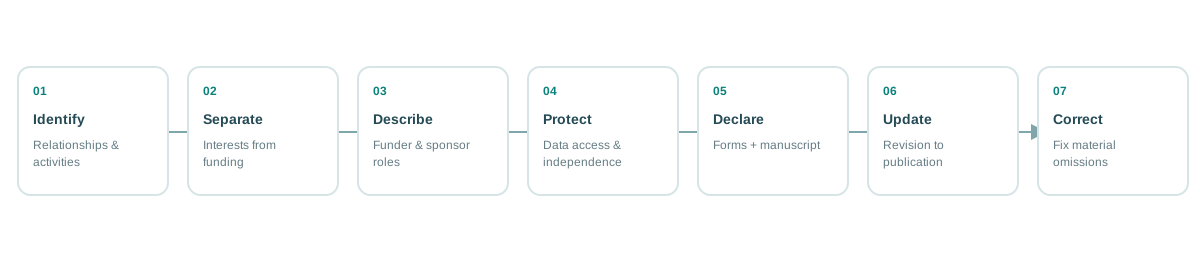
Treata authors should disclose relevant financial and non-financial relationships transparently; report direct funding and in-kind support accurately; describe sponsor involvement in design, conduct, analysis, writing and publication; preserve meaningful author access to data and scientific independence; and update or correct material disclosure information when necessary.
Treata journals may configure the disclosure period, required forms, manuscript wording, sponsor-role fields, funding metadata and author confirmations. Those journal-specific settings operate in addition to the canonical publisher policy on Competing Interests & Disclosure (TS-COI-001).
The practical rule is simple: do not ask whether a relationship proves bias. Ask whether a reasonable editor or reader would need to know it in order to evaluate the work with appropriate context.
Related author guidance
Continue preparing your submission
Canonical Treata standards