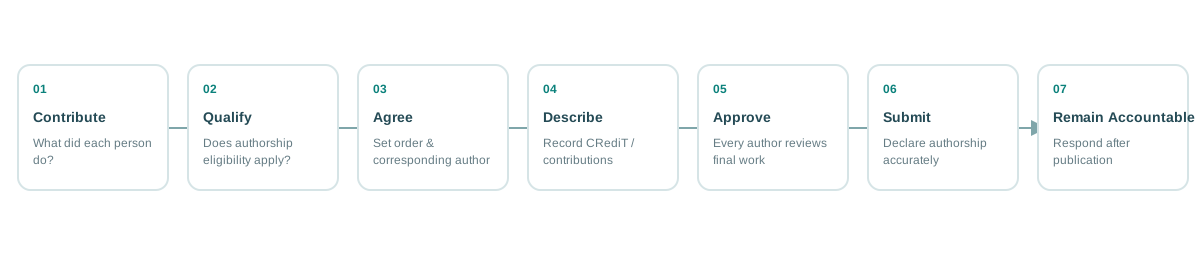
Why Authorship Requires Both Credit and Accountability
Authorship identifies people who receive scholarly credit and who accept responsibility for the published work. It should never be treated as a courtesy, reward, bargaining tool, employment benefit or automatic consequence of seniority.
Determine Authorship Early
Discuss expected authorship when the project is planned, revisit it as contributions evolve, and confirm the final author list before submission. Early documentation reduces later misunderstanding but does not freeze authorship when real contributions change.
Treata Eligibility Principle
For biomedical and health-science publishing, Treata’s publisher-level approach is developed with reference to the current ICMJE authorship framework: substantive contribution to the work; participation in drafting or important intellectual revision; final approval; and agreement to accountability. Target journals may state additional discipline-specific requirements.
Substantive Contribution
A qualifying contribution can arise through conception or design, acquisition, analysis or interpretation of data, provided the contributor also satisfies the remaining authorship requirements. One isolated task should not automatically be converted into authorship.
Drafting or Critical Intellectual Revision
Authors should participate in writing or critically revising the manuscript for important intellectual content. Merely proofreading, approving grammar, or performing routine technical editing does not by itself establish authorship.
Final Approval
Every author should review and approve the version that is submitted and, ultimately, the version to be published. Approval should be meaningful; adding a person who has never seen the manuscript is incompatible with responsible authorship.
Accountability for the Work
Authors are accountable for their own contributions and should be able to identify who is responsible for other major parts of the work. They should cooperate when questions about accuracy or integrity arise.
Do Not Deny Contributors the Opportunity to Qualify
A person who has made a substantive contribution should not be excluded from authorship simply by denying them an opportunity to participate in drafting, revision or final approval. Authorship criteria should not be weaponized to remove legitimate contributors.
Author Order Is a Group Decision
Author order can have different meanings across disciplines. Treata does not impose a universal interpretation of first, middle or last position. The author group should agree on ordering and follow the target journal’s rules for equal contribution or shared senior authorship.
First and Co-First Authors
Where a journal permits equal first authorship, the designation should reflect genuinely comparable contribution and should be agreed by the author group. Equal-contribution notes do not remove the need for each named author to satisfy authorship requirements.
Senior and Last Author Positions
In some disciplines the last position can indicate senior leadership, but this convention is not universal. Seniority, supervision, department leadership or laboratory ownership alone should not create authorship.
The Corresponding Author
The corresponding author is the primary communication point with the journal and commonly coordinates submission requirements, author information, ethics documentation, registration, disclosures and responses. The role does not give unilateral authority over authorship or the scientific record.
Corresponding Author Availability
The corresponding author should remain reachable during submission, peer review and production and, where reasonably possible, after publication for questions about the article. Stable contact information is preferable.
Multiple Corresponding Authors
Some journals permit more than one corresponding author. When allowed, responsibilities should be clear and metadata should follow the journal’s configuration. Multiple corresponding authors do not divide away the accountability of the full author group.
CRediT Is a Contribution Taxonomy, Not an Authorship Test
CRediT provides 14 standardized contributor roles and can make contributions more transparent. Assignment of a CRediT role does not automatically make someone an author, and lack of a particular role does not automatically disqualify an otherwise eligible author.
CRediT — Conceptualization
Use for ideas and formulation or evolution of overarching research goals and aims. Conceptualization can be a major intellectual contribution but should be assessed together with the journal’s authorship requirements.
CRediT — Methodology
Use for development or design of methodology and creation of models where applicable. Distinguish intellectual methodological work from routine execution of a predefined procedure.
CRediT — Software and Formal Analysis
Software covers programming, implementation and maintenance of relevant code; Formal analysis covers application of statistical, mathematical, computational or other formal techniques. Describe the actual contribution rather than assigning roles cosmetically.
CRediT — Investigation and Data Curation
Investigation covers conducting the research and evidence/data collection; Data curation covers management, annotation, cleaning and maintenance of data for use and reuse. These roles can be substantial but do not alone determine authorship.
CRediT — Resources and Validation
Resources includes provision of study materials, specimens, computing resources or other tools; Validation covers verification of reproducibility or replication of results or outputs. Record these contributions accurately.
CRediT — Visualization
Use for preparation, creation and presentation of published visualizations or data presentation. Routine formatting of an already-created figure should not be inflated into a larger contribution.
CRediT — Funding Acquisition
Use when a contributor obtained financial support leading to the publication. Funding acquisition alone is generally insufficient for authorship under the ICMJE framework.
CRediT — Project Administration and Supervision
Project administration covers management and coordination; Supervision covers oversight and leadership responsibility for research planning and execution. Neither role should be treated as automatic authorship solely because of position or authority.
CRediT — Writing: Original Draft
Use for preparation or creation of the initial published work, including substantive drafting. Identify genuine writing contributions and avoid using this role to conceal professional or uncredited writers.
CRediT — Writing: Review & Editing
Use for critical review, commentary or revision of the work during pre- or post-publication stages as appropriate. Routine proofreading alone should not be overstated as substantive intellectual revision.
Assign CRediT Roles Transparently
One contributor can hold multiple roles and one role can be shared by several contributors. Where the implementation permits, contribution degree may be indicated. All contributors should have an opportunity to review how their roles are represented.
Contribution Statements Must Match Reality
Do not assign roles merely to make every author appear equally involved or to satisfy a template. Contribution statements can become relevant during integrity inquiries, so they should reflect contemporaneous project records.
Group and Consortium Authorship
Large collaborations may use a group name, individual author names, or a combination according to journal rules. The submission should distinguish people who qualify as authors from collaborators or non-author contributors.
Responsibilities in Large Collaborations
Large author numbers do not reduce individual responsibility. The collaboration should define who can take credit and responsibility, how contributions are recorded, and who communicates with the journal.
Acknowledgements and Non-Author Contributors
People who contributed but do not meet authorship requirements can be acknowledged with their contribution described. Examples may include technical support, language editing, administrative support or scientific advice that did not rise to authorship.
Permission to Acknowledge
Because acknowledgement can imply involvement or endorsement, authors should obtain permission where required by the journal or appropriate publishing practice before naming an individual.
Honorary, Gift and Guest Authorship
Do not add a person because of status, prestige, hierarchy, funding influence, anticipated favor, reciprocal arrangements or a desire to improve acceptance prospects. Authorship must reflect qualifying contribution and accountability.
Ghost Authorship
Do not omit someone who made a contribution that qualifies for authorship, and do not hide substantial writing or analytical involvement that should be transparently disclosed. Professional assistance should be credited according to its actual role and journal policy.
Authorship for Students and Early-Career Researchers
Career stage does not change the eligibility standard. Supervisors should not appropriate first authorship or remove junior contributors who qualify, and junior researchers should not be named solely to provide career credit when they do not qualify.
Local Researchers and International Collaborations
Research teams should consider meaningful inclusion of researchers who contribute local knowledge, data collection, interpretation and context. Authorship decisions should avoid extractive practices in which local intellectual contributions are minimized or erased.
Changes Before Submission
If contributions change during the project, update the planned author list and contribution record before submission. Resolve disagreements while project records and responsibilities are still clear.
Adding an Author After Submission
A request to add an author should explain why the person was omitted or why their contribution changed, identify their contribution, and obtain the agreements required by the journal. The editor may pause processing while the request is assessed.
Removing an Author After Submission
Removal should not be used to suppress a dissenting contributor or simplify a dispute. Journals can request a reason and written agreement from all affected authors before changing the byline.
Changing Author Order After Submission
Requests to reorder authors should be transparent and agreed by the author group under journal procedures. A change in order can have academic consequences even when the membership of the author group remains the same.
Authorship Changes After Acceptance
Late changes deserve particular scrutiny because editorial evaluation has already occurred under a defined author record. Provide a clear explanation, updated contribution information and required author confirmations.
Authorship Changes After Publication
Published authorship is part of the scholarly record. Legitimate changes generally require formal correction or another documented publishing action rather than silent metadata editing.
Authorship Disputes
Editors can enforce journal policy and request documentation, but they are generally not the appropriate body to adjudicate contested claims about who deserves authorship. Unresolved disputes may need institutional or other competent investigation.
Do Not Use Peer Review to Settle Authorship Disputes
Peer review evaluates the manuscript; it is not a mechanism for deciding employment, laboratory or interpersonal disputes about credit. Disputes should be disclosed to the journal when they affect the submission and addressed through appropriate institutional processes.
Deceased Authors Before Submission
A deceased contributor may be included as an author when the person made qualifying contributions before death and the journal’s policy permits it. The author group should disclose the death to the journal and describe how final approval/accountability requirements are handled under the journal’s procedure.
Death During Review or Production
If an author dies after submission, notify the journal promptly. The journal may request confirmation from the remaining authors and may add an appropriate note. Do not silently remove the author or alter contributions.
Deceased Authors and Competing Interests
Where possible, disclose relevant relationships and contribution information for a deceased author using available records and co-author knowledge. The journal may determine how limitations in obtaining declarations are stated.
AI Systems Cannot Be Authors
AI-assisted technologies, chatbots and generative systems cannot satisfy human authorship accountability and should not be listed as authors or co-authors. Human authors remain responsible for submitted material.
Disclose AI-Assisted Work
When AI-assisted technology is used, follow the journal’s disclosure rules and explain its role in the appropriate location. Writing assistance, research methods, analysis, image generation or other uses can require different forms of disclosure.
Human Verification of AI Output
Authors must verify AI-assisted text, citations, calculations, code, analyses and images. AI use does not transfer responsibility for plagiarism, fabrication, errors, bias, copyright problems or confidentiality breaches.
AI and CRediT
Do not assign CRediT roles to an AI system as though it were a human contributor. The human contributors responsible for conceptual, analytical, writing and verification work should be identified according to actual contributions.
Authorship and Data Access
Authors responsible for analysis and interpretation should have sufficient access to relevant data and information to fulfill their accountability. Agreements with sponsors or institutions should not prevent responsible authors from understanding and defending the work they publish.
Sponsor and Funder Influence
A sponsor, funder or employer should not determine authorship merely by financial power or contractual position. Funding acquisition should be disclosed and credited appropriately without converting financial support into honorary authorship.
Commercial and Professional Writing Support
Medical writers, statisticians, editors, translators or other professionals should be credited according to their actual contribution. If their contribution meets authorship criteria, they should not be hidden in acknowledgements merely because they were paid.
Affiliations Do Not Determine Authorship
Institutional affiliation indicates organizational connection; it is not evidence of contribution. Do not add department heads or institutional leaders solely to display affiliation or authority.
ORCID Does Not Establish Eligibility
ORCID helps identify researchers but does not prove contribution or authorship qualification. Verify identifiers carefully while making authorship decisions independently.
Accountability When Work Is Divided
Modern research can be highly specialized. An author is not expected to reproduce every co-author’s expertise, but should understand the overall work sufficiently to identify responsibility and have confidence in the integrity of co-authors’ contributions.
Responsibility for Integrity Concerns
If an author learns of a material error or integrity concern, they should cooperate with co-authors, institutions and the journal to investigate and correct the record where necessary. Silence after publication can conflict with authorship accountability.
Responsibility for Corrections and Retractions
Authors should assist with corrections, retractions or expressions of concern when the scholarly record requires action. Disagreement among authors does not necessarily prevent a journal from taking necessary editorial action.
Authorship Documentation to Preserve
Retain contribution records, author approvals, key correspondence, conflict disclosures and records of agreed authorship changes. For large projects, structured contributorship records should be maintained throughout the project.
Final Authorship Verification Before Submission
Before submission, confirm the exact author names and order, affiliations, corresponding author, ORCID identifiers where used, contribution statement, acknowledgements, disclosures, final approval and any group-authorship information.
Treata Authorship Decision Rule
Credit should follow real contribution; authorship should include accountability; contributorship should be transparent; non-author contributions should be acknowledged appropriately; and changes to the author record should be documented rather than informal.
Journal-Specific Configuration
Each Treata journal may configure author limits, equal-contribution notes, group-authorship presentation, corresponding-author rules, CRediT requirements and submission declarations. Those operational settings apply in addition to the publisher-level principles in this manual.
Related author guidance
Continue preparing the author record
Canonical Treata standards